Lead qualification is the process of evaluating whether a prospect has the budget, authority, need, and timeline to buy. The best practices combine a structured framework like BANT or MEDDIC with automated scoring, prompt follow-up, and CRM-tracked signals to focus sales effort only on prospects most likely to convert.
Every sales team has felt the frustration of spending weeks nurturing a prospect only to hear "we don't have budget" or "the decision-maker is someone else." This is not a closing problem. It is a qualification problem. When you qualify rigorously at the top of the funnel, you protect your most finite resource: sales time.
Lead qualification is the discipline of separating prospects who can and will buy from those who cannot or will not, at least not now. Done well, it transforms a noisy pipeline into a focused, predictable revenue engine. This guide covers the frameworks, questions, scoring models, and AI-driven tactics that Indian SMBs and growth-stage sales teams are using in 2026 to qualify faster and close more.
What Is Lead Qualification?
Lead qualification is a structured evaluation process that determines whether an inbound or outbound prospect meets the criteria your business needs before investing significant sales resources. A qualified lead has demonstrated a combination of fit (industry, company size, geography), intent (active problem awareness, research behaviour), and readiness (budget allocated, decision authority, near-term timeline).
Qualification sits between lead generation and active selling. Without it, your sales reps become glorified order-takers who waste cycles on unwinnable deals. With it, every conversation is purposeful and every proposal has a genuine chance of closing. It is also the bridge between marketing and sales, ensuring that only leads meeting agreed criteria get handed over to account executives.
Why Qualification Drives Revenue
Research consistently shows that sales teams spending the most time on well-qualified leads outperform peers by a wide margin. A 2026 study of B2B sales cycles found that reps who use a formal qualification checklist close at 3.2 times the rate of those who rely on gut instinct alone. The reasons are structural:
- Reduced cost per acquisition: Fewer demos, fewer proposals, and fewer follow-up cycles on dead-end deals mean lower operational cost per closed deal.
- Shorter sales cycles: Qualified buyers already understand the problem. Conversations skip the education phase and move quickly to solution fit.
- Better forecasting: When qualification criteria are consistent across the team, pipeline stages become reliable predictors of revenue.
- Higher team morale: Reps who win regularly stay motivated. Persistent losses on unqualified leads breed burnout and attrition.
"A pipeline full of unqualified leads is not an asset. It is a liability disguised as activity." Sales teams that ruthlessly qualify early spend less time and close more, every single quarter.
For Indian SMBs competing with enterprise players on limited headcount, qualification is even more critical. You cannot afford to assign three follow-up calls to a prospect who has no buying authority. Learning to identify high-value leads early is one of the highest-leverage skills a growth-stage team can build.
Top Qualification Frameworks: BANT, MEDDIC and More
Several structured frameworks exist to guide qualification conversations. Each has strengths depending on your deal complexity and sales motion.
BANT
BANT (Budget, Authority, Need, Timeline) is the classic framework and still the most practical for SMB sales cycles in India. It maps neatly to the four questions every salesperson needs answered before investing serious time in a deal.
| Letter | Question to Explore | Red Flag Answer |
|---|---|---|
| B - Budget | Has the company set aside money for this solution? | "We haven't discussed budget yet." |
| A - Authority | Who makes the final call? Are you speaking to them? | "I'll need to check with my boss." |
| N - Need | What specific pain is driving the search for a solution? | "We're just exploring options." |
| T - Timeline | When does the company need the solution live? | "No rush, sometime this year." |
MEDDIC
MEDDIC (Metrics, Economic Buyer, Decision Criteria, Decision Process, Identify Pain, Champion) is preferred for complex B2B deals with multiple stakeholders. It forces reps to map the internal buying committee and quantify the business impact of solving the problem, making it harder for deals to stall at the last hurdle.
CHAMP
CHAMP reorders the classic criteria, putting Challenges first, ahead of budget. This is particularly effective in outbound sequences where prospects have not yet acknowledged a problem. By opening with challenges, you create the need before you discuss the solution.
Building a Lead Scoring Model
A lead scoring model assigns numerical values to prospect attributes and behaviours so that sales and marketing teams can prioritise objectively rather than intuitively. A basic model has two components: demographic fit and engagement score.
Demographic fit scoring rewards attributes that match your ideal customer profile. For an Indian SaaS company targeting mid-market businesses, you might score: company size 50-500 employees (+20 points), industry match (+15 points), decision-maker title (+10 points), and location in Tier 1 city (+5 points). Mismatches remove points.
Engagement scoring tracks behavioural signals: pricing page visited (+15), demo requested (+30), case study downloaded (+10), email opened three-plus times (+8), LinkedIn profile visited your page (+5). Negative scores matter too: unsubscribed from email (-20), no activity in 30 days (-10).
Once you set thresholds, say 60+ = Marketing Qualified Lead (MQL) and 85+ = Sales Qualified Lead (SQL), the routing becomes automatic. This is exactly how the best lead generation tools for Indian businesses separate surface-level interest from genuine purchase intent before a single sales call is made.
The Right Qualification Questions to Ask
The best qualification questions are open, non-leading, and designed to surface the truth quickly. Avoid yes/no questions that let prospects stay vague. Instead, use exploratory questions that require specific answers:
- On pain: "What is this problem currently costing you in time, money, or missed opportunities each month?"
- On authority: "When a decision like this moves forward, who typically champions it internally and who needs to sign off?"
- On timeline: "Is there a specific event or deadline, say a quarter-end review or a product launch, driving your need to solve this?"
- On alternatives: "What happens if you don't solve this in the next 90 days?"
- On budget: "Most companies in your situation invest between X and Y to solve this. Does that range work for you?"
Notice that the budget question is framed as a range rather than a direct ask. This technique, called anchoring, gets a more honest response because the prospect is reacting to a reference point rather than generating a number in isolation. Pair these questions with active listening. The pause after a tough question is often where the most revealing answers live.
Using AI and Automation to Qualify at Scale
Manual qualification works for small pipelines. At scale, it breaks down. AI changes this entirely by enabling continuous, real-time qualification across hundreds or thousands of prospects simultaneously.
Modern AI-powered CRMs can analyse email open patterns, website behaviour, WhatsApp response rates, and LinkedIn activity to build a dynamic qualification score that updates hourly. They can also trigger automated follow-up sequences the moment a prospect crosses a score threshold, ensuring no warm lead goes cold because a rep was busy with another call.
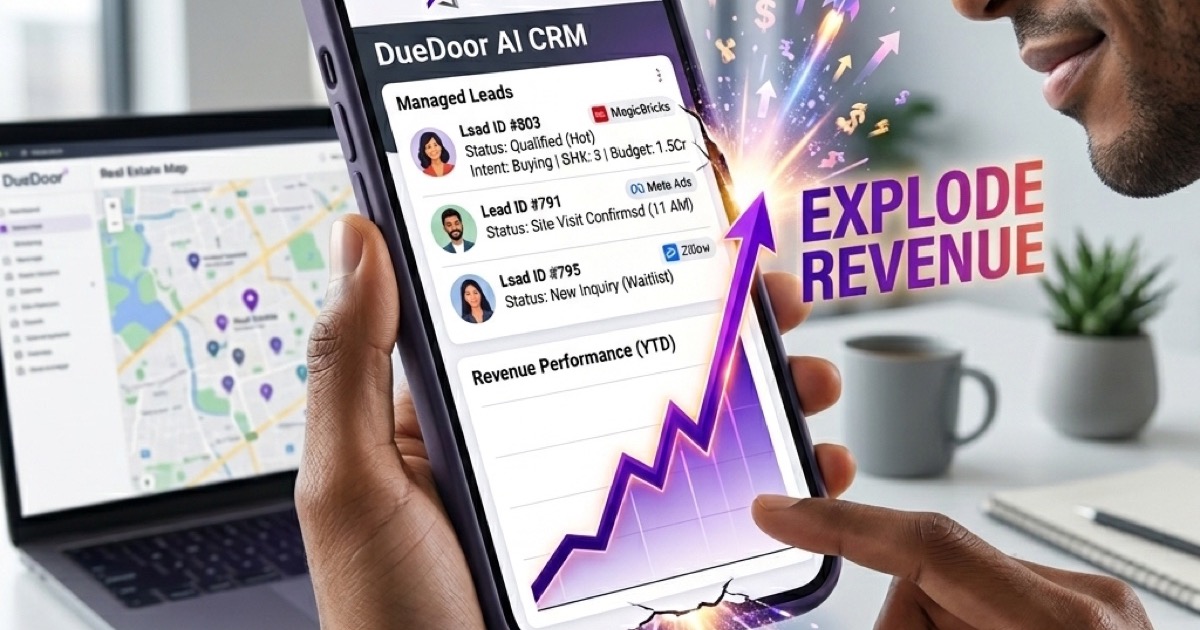
DueDoor's AI Growth CRM is built specifically for this kind of intelligent qualification. Its pipeline automatically segments prospects by engagement level, surfaces the next best action for each lead, and routes hot prospects to human reps while nurturing cooler ones through automated WhatsApp and email sequences. For teams using WhatsApp as a primary channel, understanding effective WhatsApp marketing for lead generation helps tie messaging strategy directly into the qualification workflow.
AI calling agents are a particularly powerful qualification tool for high-volume pipelines. An AI SDR can call 200 inbound leads in the first hour after sign-up, ask the five BANT questions, record the answers, update the CRM score, and escalate only the qualified ones to a human rep. This is not a future capability. Indian sales teams are deploying it today.
Common Qualification Mistakes to Avoid
Even experienced sales teams fall into predictable traps. Here are the most costly ones:
- Qualifying too late: Running a full discovery call before checking basic fit criteria wastes everyone's time. Add a two-question pre-qualification form to your inbound demo request flow.
- Accepting vague answers: "We have budget" is not a qualified answer. Push for specifics: "Roughly what range are you working with?" Politely persistent beats politely passive.
- Ignoring disqualification signals: If a prospect has missed three follow-up appointments, that is a signal. Chasing them is hope masquerading as strategy. Move them to a long-term nurture sequence and free up the rep's time.
- Over-relying on job title: In Indian SMBs especially, founders and directors often delegate tool evaluation to junior team members. A VP title does not guarantee decision-making authority. Always map the buying committee.
- Treating qualification as a one-time event: A prospect qualified in January may lose budget by March. Re-qualify at every major pipeline stage, not just at the top of the funnel.
For real estate businesses, where the buying cycle can stretch months and involve multiple influencers, additional nuance is needed. A CRM comparison for Indian real estate shows how industry-specific qualification criteria, like property type preference, loan pre-approval status, and site-visit readiness, need to be embedded directly into the pipeline stage logic.
From Qualification to Conversion
Qualification is not the finish line. It is the starting gate for your conversion process. Once a lead clears your qualification threshold, the handoff to active selling must be seamless. The rep should receive a full context brief: the prospect's score, the engagement history, the specific pain points surfaced during qualification, and the recommended next step.
Speed matters enormously here. Studies consistently show that leads contacted within 48 hours of qualifying are dramatically more likely to convert than those reached a week later. Automated CRM alerts, calendar integrations, and WhatsApp nudges keep reps responsive without requiring them to manually monitor every lead. A strong follow-up protocol, including the right cadence and channel mix, is covered in detail in this guide on following up with leads on WhatsApp.
The final piece is measurement. Track your SQL-to-close rate by qualification source, by rep, and by lead origin. If LinkedIn-sourced leads close at 28% but paid-search leads close at 9%, that is a qualification problem, not a closing problem. The paid-search leads are probably clearing a threshold that is set too low. Tighten the criteria and watch conversion rates recover. For the complete conversion playbook once leads are qualified, see this guide on how to convert leads into customers.
DueDoor's pipeline dashboards make this analysis effortless. Every stage transition is logged, every score change is recorded, and conversion rates by source and rep are visible in real time. When qualification criteria need tuning, the data tells you exactly where to look, and changes propagate instantly across the automated follow-up sequences.
Ready to build a qualification engine that fills your pipeline with deals you can actually close? Explore DueDoor's AI-powered Growth CRM and see how automated scoring, WhatsApp follow-up, and AI calling work together to qualify and convert more leads with less manual effort. Start your free DueDoor trial today and put your qualification process on autopilot.
Frequently Asked Questions
What is the difference between a marketing qualified lead and a sales qualified lead?
A marketing qualified lead (MQL) has shown enough interest and fits your target profile to justify marketing attention, such as email nurture or retargeting. A sales qualified lead (SQL) has been further vetted, usually by a rep or an AI tool, and meets the criteria for direct sales engagement including confirmed budget, authority, and near-term need.
Which lead qualification framework is best for Indian SMBs?
BANT (Budget, Authority, Need, Timeline) is the most practical starting point for Indian SMBs because it is simple to train on and covers the four core variables that determine deal viability. For complex B2B deals with multiple stakeholders, layering in elements of MEDDIC, specifically mapping the economic buyer and decision process, adds significant rigour.
How do I qualify leads that come in through WhatsApp?
WhatsApp qualification works best with a structured conversational flow. Send a warm welcome message, then ask two or three short questions covering the prospect's role, the problem they are trying to solve, and their timeline. You can automate this with WhatsApp Business API chatbots that score responses and route high-scoring leads to a human rep within minutes.
How often should I re-qualify leads in my pipeline?
Re-qualify at every major stage transition and at minimum every 30 days for deals that have been in the pipeline more than a month. Budget approval statuses, decision-maker roles, and project timelines change frequently, especially in Indian businesses where financial year planning, GST cycles, and board approvals can shift priorities quickly.
Can AI fully replace human qualification calls?
For high-volume inbound pipelines, AI can handle 70 to 80 percent of initial qualification autonomously, scoring leads based on behaviour, firmographics, and structured conversation responses. However, complex enterprise deals with multiple stakeholders still benefit from a skilled human rep who can read nuance, build rapport, and navigate political dynamics that AI cannot yet fully replicate.
Every lead gets an instant, qualified reply — even at 3 AM
DueDoor's AI reads the inbound WhatsApp, understands pricing/demo/support intent, replies with the right answer, and books the meeting — all in under 4 seconds. No human lifts a finger until the call itself.
- AI understands Hindi, Tamil, Telugu, Marathi, English
- Qualifies budget, team size, timeline automatically
- Books into your actual Google/Outlook calendar
- Escalates to a human only when the AI isn't 95%+ sure
WhatsApp AI
Auto-reply, drip sequences, AI qualification — 24/7.
Leads & Pipeline
Smart lead scoring with auto-routing to your team.
Email Marketing
Personalized AI emails that actually get opened.
Meta Ads AI
One-click campaigns optimized by AI daily.
SEO Engine
Content + ranking on autopilot. Like this page.
LinkedIn (PhewDo)
Outreach + replies handled end-to-end.