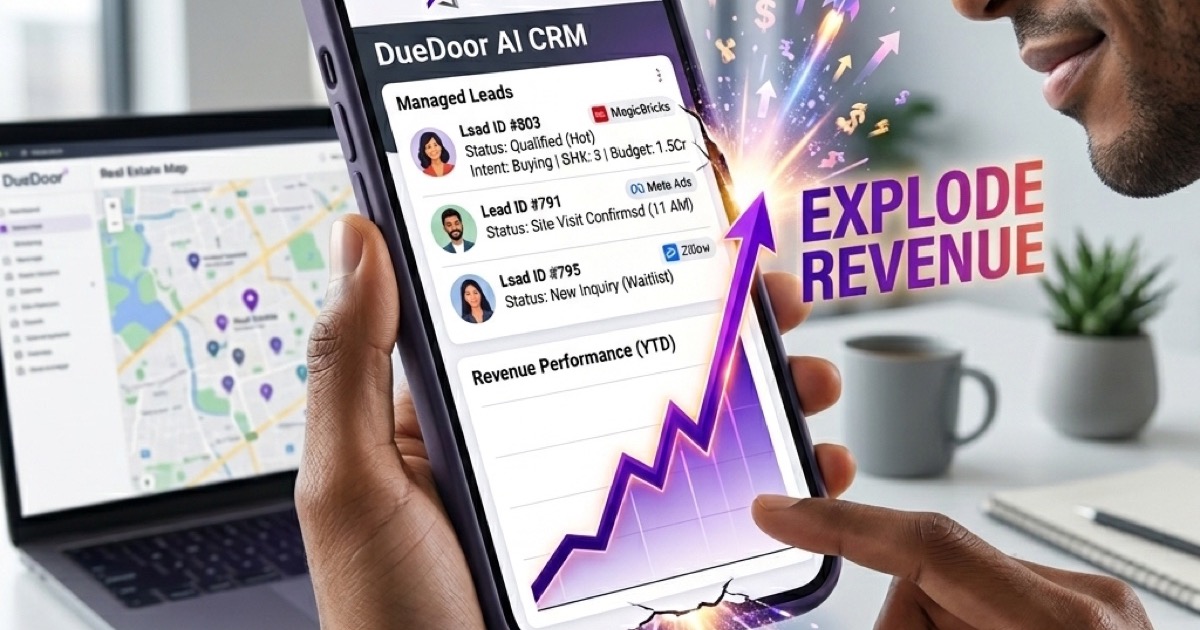
The best listing strategies for real estate combine accurate price positioning, high-quality visual content, multi-platform distribution, and automated lead follow-up to attract serious buyers and close deals faster.
Real estate in India has never been more competitive. Whether you are listing a 2BHK in Pune, a commercial plot in Hyderabad, or a luxury villa in Goa, buyers today are better informed, more demanding, and quicker to move on if they do not like what they see. A property sitting unsold for even 30 extra days can cost a seller lakhs in holding costs, loan interest, and opportunity value.
The agents and brokers closing deals fastest in 2026 are not simply listing on MagicBricks and waiting. They are combining sharp pricing science, cinematic visual content, cross-platform syndication, and AI-assisted lead management into a repeatable system. This guide breaks down every layer of that system so you can apply it regardless of your market segment or city.
Why Your Listing Strategy Determines the Sale
Most sellers focus on the property itself: renovation, staging, paperwork. Most agents focus on their commission structure. Yet neither of these determines how fast a property sells or at what price. The listing strategy does. A listing strategy is the deliberate plan covering how a property is priced, presented, distributed, and followed up on from day one to the day of registration.
Research from the National Association of Realtors consistently shows that homes marketed with a comprehensive strategy sell 18 to 24 percent closer to asking price and in roughly half the time compared to ad-hoc listings. In the Indian context, where buyers routinely negotiate down 10 to 15 percent, having a defensible strategy from the start is the difference between a good deal and a distress sale.
"A property is only as visible as the strategy behind it. You can have the best flat in Whitefield, but if no one finds it in time, or if the right buyer gets a slow response, the deal dies on the table." - Senior Property Consultant, Bengaluru
Price Positioning: The First and Most Critical Move
Incorrect pricing is the single biggest reason listings stagnate. Overpriced properties scare off buyers who feel they cannot negotiate to a fair value. Underpriced properties move fast but leave money on the table and sometimes trigger suspicion about hidden defects.
How to price with precision in 2026
- Pull hyperlocal comparables: Focus on transactions registered within the same society, tower, or street in the last 90 days. Avoid relying on listing prices, which are aspirational. Use SRO-registered sale data wherever available.
- Apply a sentiment index: Is your micro-market seeing rising enquiries (bullish) or falling foot traffic (cautious)? Adjust your anchor price by 3 to 5 percent accordingly.
- Set a psychological price point: Listings priced just below a round number, such as Rs 89.5 lakh instead of Rs 90 lakh, appear in a wider set of portal search results and feel more negotiable to buyers.
- Build in a negotiation buffer: Indian buyers expect to negotiate. If your true target is Rs 85 lakh, listing at Rs 87 to 88 lakh gives room without appearing greedy.
Visual Content That Wins Buyer Attention
On any major portal, a buyer scrolls through dozens of listings in minutes. The ones that stop the scroll share one characteristic: exceptional visuals. Professional photography increases click-through rates by up to 3.4 times compared to mobile phone photos, according to data published by Zillow Research. The same principle holds on 99acres or Housing.com.
Beyond standard photography, here is what top-performing listings in 2026 are using:
- Twilight and golden-hour exterior shots: A facade photographed at dusk with interior lights on creates emotional warmth that daytime shots cannot match.
- 360-degree virtual tours: Tools like Matterport and Cupix allow buyers to walk through a property remotely. This is particularly effective for NRI buyers and out-of-city investors.
- Drone footage for plotted developments and villas: Aerial video communicates scale, neighbourhood context, and proximity to landmarks far better than any ground-level photograph.
- Short-form video reels: A 60 to 90-second reel edited for Instagram or YouTube Shorts can generate thousands of views organically if the property has strong visual appeal.
Pair your visuals with a compelling property description. Use specific sensory language ("morning light floods the east-facing master bedroom") rather than generic adjectives ("spacious and well-maintained"). Mention exact distances to Metro stations, schools, and hospitals in minutes, not vague phrases like "close to everything".
Multi-Platform Distribution for Maximum Reach
Listing on a single portal in 2026 is the equivalent of opening a shop and keeping the shutters half-down. Serious buyers are simultaneously browsing MagicBricks, 99acres, Housing.com, NoBroker, and increasingly discovering properties through Instagram, Facebook Marketplace, and Google Search.
The table below maps distribution channels to buyer intent levels, helping you prioritise where to invest time and ad budget.
| Channel | Buyer Intent | Best Use Case | Estimated Cost (2026) |
|---|---|---|---|
| MagicBricks / 99acres | High | Active searchers with budget in mind | Rs 2,000 to Rs 8,000 per listing/month |
| Housing.com / NoBroker | High | First-time buyers, millennials | Rs 1,500 to Rs 5,000 per listing/month |
| Google Search Ads | Medium-High | Buyers researching locality-specific | Rs 15 to Rs 80 per click |
| Instagram / Facebook Reels | Medium | Aspirational buyers, NRI community | Rs 500 to Rs 3,000 per campaign |
| WhatsApp Broadcast | High (warm leads) | Existing pipeline, referral network | Near zero (platform cost only) |
| Medium | Commercial real estate, HNI investors | Rs 800 to Rs 2,500 per campaign |
Managing listings across all these platforms manually is time-consuming and error-prone. Tools built for listing management in India can sync property details, photos, and pricing updates across portals from a single dashboard, saving agents several hours per listing cycle.
Lead Follow-Up Automation: Where Most Agents Fail
Here is a harsh truth: studies from the real estate sector consistently show that 60 percent or more of property enquiries never receive a response within the first hour. In a market where a buyer is simultaneously enquiring on 5 to 10 listings, the first agent to respond with relevant information wins the site visit. First response time under 5 minutes increases conversion to site visit by over 400 percent.
Manual follow-up at this speed is impossible if you are managing more than 3 to 4 active listings. Automation is the only answer. A well-configured real estate lead management tool can:
- Instantly send a personalised WhatsApp message to every new portal enquiry with property brochure, virtual tour link, and a booking CTA
- Qualify lead intent automatically via a chatbot that asks budget, timeline, and configuration preferences
- Score and route hot leads to the listing agent's phone in real time
- Drip nurture cold leads with follow-up messages over 7, 14, and 30 days without manual effort
- Log every interaction in a pipeline so no lead is ever forgotten or double-contacted
DueDoor's AI Growth CRM is used by real estate teams across India to do exactly this. Its WhatsApp Business API integration, AI calling module, and pipeline automation work together to ensure that every enquiry from every portal gets an instant, professional, and personalised response at any hour.
CRM and Listing Tools That Multiply Agent Output
The average independent real estate agent in India manages 15 to 40 active listings and hundreds of leads simultaneously. Without the right tech stack, this volume is unmanageable. The right tools do not replace agent expertise: they amplify it.
When evaluating your tech stack, consider three categories. First, listing distribution tools that push to multiple portals and update changes automatically. Second, lead capture and CRM tools that aggregate enquiries from WhatsApp, portals, website forms, and social media into one unified inbox. Third, communication and nurture tools that automate follow-up sequences while maintaining a personalised, human tone.
For teams on a budget, affordable CRM solutions built for Indian businesses now offer enterprise-grade automation at SMB pricing, starting under Rs 3,000 per month. The ROI on closing even one additional deal per quarter from better lead management is enormous compared to this cost.
DueDoor is one such platform, combining AI lead generation, WhatsApp automation, LinkedIn outreach, and a full sales pipeline into a single dashboard designed specifically for growth-oriented Indian businesses including real estate teams.
Common Pitfalls That Kill Good Listings
Even experienced agents fall into patterns that undermine otherwise strong listings. Understanding common mistakes in real estate listings helps you audit your current approach and fix gaps before they cost you a deal.
- Stale listing photos: Photos taken 6 months ago during monsoon look very different from the sunny property a buyer visits. Refresh visuals every season or after any renovation.
- Incomplete RERA details: Any residential project launched after 2017 must display the RERA registration number prominently. Missing this erodes buyer trust instantly.
- Generic descriptions recycled across properties: Copy-pasted descriptions signal laziness and lower your portal search ranking. Write unique descriptions for each listing.
- Ignoring negative reviews or portal questions: Buyers who post a question on a listing and receive no answer assume the worst. Respond to every query within 24 hours.
- No clear call to action: Every listing should have one primary CTA. "WhatsApp us for a virtual tour" or "Book a site visit this weekend" outperform vague "Contact for details" every time.
You can also explore a deeper breakdown of common issues with property listings to audit your pipeline for structural problems that hurt conversion across all your active inventory.
Putting It All Together: Your 30-Day Listing Plan
Winning listings are not built in a day, but the foundation can be laid in the first week. Here is a practical 30-day roadmap for any new listing:
- Days 1 to 3: Price analysis using registered comparable data. Professional photography and virtual tour shoot. Write unique, sensory-rich property description with specific locality highlights.
- Days 4 to 7: Publish across all portals simultaneously. Launch targeted WhatsApp broadcast to your warm database. Set up automated instant-response sequence for all enquiries.
- Days 8 to 14: Launch Google and Instagram ad campaigns with geo-targeting. Monitor portal performance and adjust headline photos or price if click-through rate is below benchmark.
- Days 15 to 21: Review lead pipeline. Call every enquiry that opened your WhatsApp message but did not reply. Offer a virtual tour or a weekend open-house slot.
- Days 22 to 30: If no offer yet, review price positioning against fresh comparables. Consider a 2 to 3 percent price adjustment. Re-launch with new photos or a freshened description to reset portal listing date.
This loop repeats until the property sells. The key is consistency, speed of follow-up, and treating every lead as a real prospect rather than a number in a spreadsheet. For teams looking to scale this system across 20, 50, or 100 listings simultaneously, a platform like DueDoor turns this 30-day manual workflow into a semi-automated engine running in the background.
Whether you are an independent broker in Chennai or a developer sales team in Navi Mumbai, the same principles apply. Accurate pricing, compelling visuals, wide distribution, and fast AI-powered follow-up are the four pillars of the best real estate listing strategies in 2026. Combine them with the right tools and you have a repeatable system for consistently outperforming the market. Ready to automate your listing follow-up and manage your entire sales pipeline in one place? Get started with DueDoor today and see how India's fastest-growing AI CRM can transform your real estate sales operation.
Frequently Asked Questions
What is the most important factor in a real estate listing strategy?
Accurate price positioning is the single most important factor. A property priced within 3 to 5 percent of true market value attracts more qualified buyers, generates more site visits, and closes faster than an overpriced listing that sits and becomes stale.
How many portals should I list a property on in India?
Aim for at least 4 to 5 portals including MagicBricks, 99acres, Housing.com, and NoBroker, plus WhatsApp broadcast to your warm database. Each portal attracts a slightly different buyer segment, and cross-platform presence dramatically increases total exposure.
How quickly should I respond to real estate enquiries?
Within 5 minutes is the gold standard. Studies show response within 5 minutes increases the chance of converting an enquiry to a site visit by over 400 percent compared to responding after an hour. Automated WhatsApp responses using a CRM like DueDoor can achieve this instantly at any time of day.
Do professional photos really make a difference for property listings?
Yes, significantly. Properties listed with professional photography receive up to 3.4 times more clicks than those with amateur phone photos and typically sell closer to asking price. For premium or luxury properties, adding a 360-degree virtual tour and drone footage further increases qualified enquiries from out-of-city and NRI buyers.
What CRM features does a real estate team need in 2026?
A real estate CRM in 2026 should include multi-portal lead aggregation, instant WhatsApp auto-response, pipeline stage tracking, AI-powered lead scoring, drip nurture sequences, and analytics on follow-up performance. Platforms like DueDoor bundle all of these for Indian SMB real estate teams at accessible pricing.
Every lead gets an instant, qualified reply — even at 3 AM
DueDoor's AI reads the inbound WhatsApp, understands pricing/demo/support intent, replies with the right answer, and books the meeting — all in under 4 seconds. No human lifts a finger until the call itself.
- AI understands Hindi, Tamil, Telugu, Marathi, English
- Qualifies budget, team size, timeline automatically
- Books into your actual Google/Outlook calendar
- Escalates to a human only when the AI isn't 95%+ sure
WhatsApp AI
Auto-reply, drip sequences, AI qualification — 24/7.
Leads & Pipeline
Smart lead scoring with auto-routing to your team.
Email Marketing
Personalized AI emails that actually get opened.
Meta Ads AI
One-click campaigns optimized by AI daily.
SEO Engine
Content + ranking on autopilot. Like this page.
LinkedIn (PhewDo)
Outreach + replies handled end-to-end.
References & further reading
- Online marketplace — Wikipedia
- Shopify (official)
- Online advertising — Wikipedia
- Marketing — Wikipedia
- Digital marketing — Wikipedia