Effective property listings combine high-quality photos, a clear and keyword-rich description, accurate pricing data, and a fast follow-up system for every inquiry. Sellers who respond to leads within five minutes are significantly more likely to close a deal.
A property listing is not just a digital notice board. It is your first sales pitch to a buyer who may be comparing dozens of options in the same neighborhood, the same price range, and the same weekend scroll session. In India's fast-moving real estate market, where portals like MagicBricks, 99acres, and Housing.com surface hundreds of competing results for every search, a poorly crafted listing disappears while a well-built one generates consistent inquiries for weeks.
The good news is that creating an effective property listing is a learnable skill. Whether you are a solo broker in Pune, a developer marketing flats in Hyderabad, or an NRI selling ancestral property remotely, the same core principles apply. This guide walks you through every layer: visuals, copy, pricing, distribution, and the lead follow-up system that turns clicks into conversations.
Why Listing Quality Decides Your Sale
Most buyers in 2026 form a strong opinion about a property within the first fifteen seconds of viewing a listing. That window is shorter than most sellers realize. A blurry cover photo, a vague headline like "3 BHK Available" with no locality, or a description that reads like a checklist of room names will push a buyer to the next result instantly. The listing is not just informational, it is competitive.
Research from leading Indian real estate portals consistently shows that listings with professional photography receive 3.4 times more inquiries than those with smartphone snapshots taken in poor lighting. Add a virtual walkthrough or a short video reel and that gap widens further. Quality signals trust. When a buyer sees a listing that is detailed, well-lit, and clearly written, they assume the seller is organized, the property is maintained, and the transaction will be smooth.
Photography and Visuals That Stop the Scroll
Hire a professional real estate photographer if the property value justifies it, and in India's metro markets it almost always does. A ₹80 lakh flat deserves a ₹3,000 photography session. The return on that investment is measurable in faster sales and stronger offers.
Practical photography checklist
- Shoot during the golden hour (early morning or late afternoon) to capture natural light in living areas.
- Clear clutter and personal items before every shoot. Buyers want to imagine themselves in the space, not study the current owner's belongings.
- Photograph every room, the building exterior, the lobby, parking, and any amenity (gym, pool, terrace) that adds value.
- Include a floor plan image. Buyers consistently rank floor plans among the most useful listing elements.
- For plots or under-construction properties, drone footage adds a sense of scale and location that ground-level shots cannot convey.
- Edit for brightness and color accuracy, but never misrepresent. Oversaturated "magazine" edits that look nothing like the real space erode trust at the site visit stage.
Short video walkthroughs posted to YouTube or Instagram Reels and embedded in your listing can extend its reach dramatically. A 90-second walkthrough captures buyers who would never read three paragraphs of description text.
Writing a Description That Converts
The listing headline must contain the property type, configuration, and locality. "3 BHK Apartment for Sale in Koramangala, Bangalore" is not glamorous, but it is exactly what a buyer types into a search bar. The headline is for search; the description is for persuasion.
Open your description with the single most compelling fact about the property. Is it the view? The price-per-sqft versus the neighborhood average? The school catchment? Lead with that. Then move through the key attributes in a logical order: size and layout, condition and age, key features, location advantages, and society or complex details.
"Buyers are not looking for a house. They are looking for the life they will live inside it. Write every sentence with that in mind."
Use specific numbers wherever possible. "1,450 sq ft with a 200 sq ft private terrace" is more convincing than "spacious with outdoor space." Mention the nearest metro station and its walking distance. Name the schools, hospitals, and supermarkets within two kilometers. These hyperlocal details answer the questions every buyer is silently asking.
Avoid filler phrases like "excellent location," "must-see property," or "priced to sell." Every competing listing uses those phrases. Instead, make a specific claim you can back up: "Walking distance to the new Line-3 metro station opening Q3 2026" or "Society has 24/7 security with biometric access."
Pricing Strategy and Market Data
Overpriced listings generate initial curiosity but rarely convert. Underpriced listings move fast but leave money on the table. The right price is anchored in comparable transactions in the same micro-market, not in what the seller needs or what a neighboring colony fetched two years ago.
| Pricing Approach | Typical Result | Best Used When |
|---|---|---|
| Market-aligned (within 3-5% of comparables) | Higher inquiry volume, faster closure | Seller wants speed and certainty |
| Aspirational (8-15% above comparables) | Lower volume, longer time on market | Unique property with limited comps |
| Price-drop strategy (start high, reduce) | Stigma risk; buyers notice stale listings | Generally not recommended |
| Competitive undercut (3-5% below market) | Multiple offers, potential bidding | Motivated seller, hot micro-market |
Always display the price in your listing rather than writing "price on request." Buyers routinely skip listings without a visible price because they assume it is outside their budget or that the negotiation will be time-consuming. Transparency at the listing stage filters for serious buyers and saves everyone time.
Multi-Platform Distribution Done Right
A single portal listing reaches one audience. A coordinated multi-platform strategy reaches the buyer wherever they spend time. For Indian real estate in 2026, the primary distribution stack looks like this: MagicBricks and 99acres for high-intent search traffic, Housing.com for premium visuals, NoBroker for direct-buyer reach, Facebook Groups and Instagram for neighborhood-specific audiences, and WhatsApp Business broadcasts for your existing network and past inquirers.
The challenge with multi-platform distribution is consistency. When you update the price or add new photos, that change must propagate across every platform simultaneously. Stale listings with old prices create buyer confusion and wasted site visits. This is where listing management software designed for Indian markets becomes genuinely useful, automating syndication and update alerts so nothing falls out of sync.
For WhatsApp outreach specifically, broadcast the listing only to contacts who have opted in or who have previously expressed interest in similar properties. Unsolicited property messages to cold contacts rarely convert and damage your professional reputation.
Managing Leads After You Go Live
This is where most property listings fail, not in the quality of the content, but in what happens after a buyer expresses interest. The average broker in India takes four to six hours to respond to a portal inquiry. By that point, the buyer has already spoken to two or three competing sellers. Speed of response is a competitive advantage.
Set up instant notifications for every inquiry channel: portal leads, WhatsApp messages, and contact form submissions. Respond with a personal message within five minutes if at all possible. Even an automated acknowledgment that promises a callback within thirty minutes keeps the buyer in your pipeline instead of moving on.
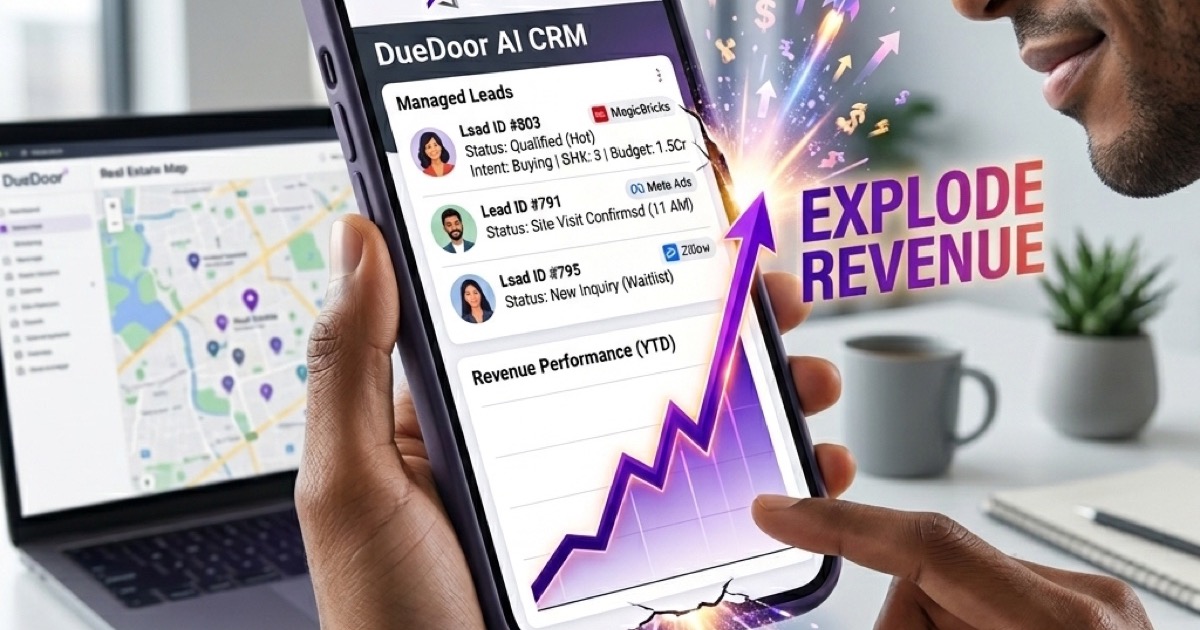
Tools built for managing real estate leads effectively can consolidate inquiries from multiple sources into a single inbox, auto-qualify leads based on budget and timeline, and trigger follow-up sequences so no inquiry slips through the cracks. DueDoor's AI Growth CRM does exactly this for Indian real estate brokers and developers, routing WhatsApp, email, and portal leads into a unified pipeline with automated follow-up reminders and stage tracking.
Qualify every lead before scheduling a site visit. Ask about budget range, timeline, financing status (self-funded vs. home loan), and whether they are the primary decision-maker. A twenty-second qualifying conversation saves hours of unproductive site visits.
Common Mistakes That Kill Your Listing
Even experienced brokers repeat the same avoidable errors. A detailed breakdown of common mistakes in real estate listings reveals that the most damaging are: missing or low-quality photos (accounts for the largest drop in inquiry volume), vague pricing, no contact information visible on social media reposts, and descriptions written in passive bureaucratic language that reads like a legal document rather than a sales pitch.
Other frequently seen problems include:
- Listing a property in the wrong category (e.g., tagging a builder floor as an "apartment" when search filters distinguish between them).
- Using only one photo when portals allow fifteen or more.
- Forgetting to mention RERA registration number, which is legally required for under-construction properties and signals credibility for resale.
- Not updating the listing after key facts change (price reduction, occupation certificate received, possession date shifted).
- Writing descriptions in all-caps or with excessive exclamation marks, which reads as unprofessional and lowers portal ranking scores on some platforms.
A practical checklist approach to common issues with property listings can help teams audit every listing before it goes live, catching errors that would otherwise cost inquiries.
Tools and Software for Smarter Listings
Technology has made it significantly easier to create, manage, and optimize property listings at scale. For a solo broker handling ten active listings, a spreadsheet and manual portal updates may suffice. But for teams, developers with large inventories, or agencies running parallel campaigns across cities, dedicated software is not a luxury, it is a necessity.
Key capabilities to look for include: multi-portal syndication, lead inbox consolidation, automated follow-up sequences (WhatsApp and email), pipeline stage tracking, and reporting on which platforms and listing types generate the most qualified inquiries. For smaller agencies on a tight budget, affordable CRM solutions built for Indian businesses offer most of these features at a fraction of enterprise pricing.
Beyond CRM, consider investing in virtual staging software for vacant properties, AI-assisted description writers that optimize for portal search algorithms, and WhatsApp Business API integrations that let buyers schedule viewings directly from a chat window. DueDoor integrates all of these capabilities, including AI-powered lead scoring, WhatsApp automation, and a sales pipeline built specifically for the way Indian real estate teams work. For agencies looking at effective marketing tools for small businesses, a unified platform that handles both listing promotion and lead management removes a significant operational burden.
The goal of every tool in your stack should be the same: reduce the time between a buyer seeing your listing and a broker having a qualified conversation. Every hour that gap shrinks is a measurable improvement in your conversion rate.
If you are ready to manage your property listings, leads, and follow-up sequences from a single AI-powered dashboard, get started with DueDoor and see how Indian real estate teams are closing more deals with less manual effort.
Frequently Asked Questions
What makes a property listing more likely to appear at the top of portal searches?
Portal algorithms typically favor listings with complete information, multiple high-quality photos, a verified contact number, a visible price, and recent activity such as updates or responses to inquiries. Keeping your listing fresh by refreshing it every few days also helps maintain visibility on most platforms.
How many photos should a property listing include?
Most portals allow between 15 and 25 photos. Use every slot available. Include shots of every room, the building exterior, parking, amenities, and the view from key windows. Listings with more photos consistently outperform those with only a few images in both click-through rate and inquiry volume.
Should I list the price or use price on request?
Always list a specific price. Buyers routinely skip price-on-request listings because they assume the property is overpriced or that negotiation will be difficult. Transparency attracts more serious inquiries and speeds up the qualification process.
How quickly should I respond to a property inquiry?
Within five minutes is the gold standard. Studies show that lead conversion rates drop sharply after the first hour. Set up instant notifications on all inquiry channels and consider automated WhatsApp responses that acknowledge the inquiry immediately while a human prepares to follow up.
Is RERA registration number required in a property listing?
For under-construction properties in India, displaying the RERA registration number is legally mandatory under the Real Estate (Regulation and Development) Act. For resale properties it is not required but including society RERA details where available adds credibility and reassures buyers about legal compliance.
Every lead gets an instant, qualified reply — even at 3 AM
DueDoor's AI reads the inbound WhatsApp, understands pricing/demo/support intent, replies with the right answer, and books the meeting — all in under 4 seconds. No human lifts a finger until the call itself.
- AI understands Hindi, Tamil, Telugu, Marathi, English
- Qualifies budget, team size, timeline automatically
- Books into your actual Google/Outlook calendar
- Escalates to a human only when the AI isn't 95%+ sure
WhatsApp AI
Auto-reply, drip sequences, AI qualification — 24/7.
Leads & Pipeline
Smart lead scoring with auto-routing to your team.
Email Marketing
Personalized AI emails that actually get opened.
Meta Ads AI
One-click campaigns optimized by AI daily.
SEO Engine
Content + ranking on autopilot. Like this page.
LinkedIn (PhewDo)
Outreach + replies handled end-to-end.
References & further reading
- Online marketplace — Wikipedia
- Shopify (official)
- Online advertising — Wikipedia
- Marketing — Wikipedia
- Digital marketing — Wikipedia