Engaging listing content combines a benefit-led headline, vivid descriptive copy, high-quality visuals, and a clear call to action. Listings that answer the buyer top three questions before they ask convert at significantly higher rates.
Your listing is your first salesperson. Before any human follows up, a potential buyer or tenant reads your headline, skims your description, and decides in under ten seconds whether to contact you or move on. In India's crowded marketplaces - from MagicBricks and 99acres to IndiaMart and Meesho - hundreds of sellers compete for the same eyeballs every hour. The listings that win are not always the cheapest or the most prominent; they are the ones whose content genuinely answers what the buyer needs to know.
Creating engaging listing content is part craft, part strategy, and part data. This guide breaks down every layer - from headline psychology to SEO keyword placement to post-publish lead tracking - so you can build listings that generate consistent, high-quality inquiries rather than random clicks that go nowhere.
Why Listing Content Decides Your Lead Quality
Most sellers treat a listing as a form to fill out rather than a piece of persuasive writing. The result is copy that technically describes a product but does nothing to move a buyer toward action. Research across Indian B2B and B2C marketplaces consistently shows that listings with structured, benefit-forward descriptions receive 3.2 times more qualified inquiries than those with bare-minimum details.
Quality matters more than quantity here. A flood of tire-kicker inquiries wastes your sales team time and drives up cost per acquisition. When your listing clearly states the price range, key specifications, delivery terms, and the unique value you bring, the leads who do contact you are already pre-qualified. They know what they want; your job is to make sure your listing is the one that answers every question before the phone rings.
Anatomy of a High-Converting Listing
Every top-performing listing shares a predictable structure. Understanding each component helps you audit existing listings and build new ones systematically.
| Element | Purpose | Common Mistake |
|---|---|---|
| Headline | Capture attention and signal relevance | Generic feature list, no benefit |
| Lead paragraph | Expand the headline with the top 2-3 buyer benefits | Repeating headline word for word |
| Feature bullets | Make scanning easy for time-poor buyers | More than 8 bullets, no hierarchy |
| Pricing context | Anchor value before buyer objects on cost | Hiding price, forcing contact for basics |
| Social proof | Reduce perceived risk with reviews or numbers | Missing entirely or placed too low |
| Call to action | Tell the buyer exactly what to do next | Vague, or duplicated three times |
| Visuals | Build trust and reduce imagination gap | Low resolution, watermarked, or irrelevant stock |
Each element must do its specific job. When one is weak, the whole listing underperforms even if the product itself is excellent.
Writing Headlines That Stop the Scroll
The headline is the single highest-leverage word in your listing. On a mobile screen, it is often the only text visible before a buyer decides to tap or scroll past. A strong listing headline follows a simple formula: Primary Benefit + Key Specification + Trust Signal.
Compare these two headlines for a commercial property listing:
- Weak: Office Space Available in Pune
- Strong: Furnished 800 sq ft Office in Koregaon Park - Ready to Move, Flexible 11-Month Lease
The second version tells a buyer exactly what they get (furnished, specific size), where it is (neighbourhood-level, not just city), and removes two common objections upfront (move-in readiness, lease flexibility). For product listings on B2B portals, the same logic applies - lead with the outcome the buyer gets, then layer in the specification.
Buyers do not buy features - they buy the removal of a specific pain. Your headline should name the pain it eliminates before it names the product that eliminates it.
Test two headline variants for every significant listing. Even small word-order changes - moving the location before the square footage, for instance - can shift inquiry rates noticeably over a two-week window.
Descriptions That Sell Without Overselling
Listing descriptions fail in one of two ways: they are either bullet-point deserts that give no emotional context, or they are breathless marketing prose so full of superlatives that buyers distrust everything. The sweet spot is conversational specificity - writing as if you are explaining the listing to a knowledgeable friend, using real numbers and honest qualifications.
Structure your description in three paragraphs. The first paragraph covers the core benefit and the ideal buyer - who this listing is perfect for and why. The second paragraph covers the specifics: dimensions, materials, certifications, warranties, delivery timelines, or whatever details your category demands. The third paragraph handles objections and closes with a soft call to action.
For real estate listings specifically, avoid vague adjectives like spacious and modern without grounding them in data. Spacious means nothing; 1,200 sq ft with 9-foot ceilings means everything. Studying common mistakes in real estate listings reveals that failing to quantify claims is the single most cited reason buyers skip a listing despite being genuinely interested in the property type.
Visuals and Media Best Practices
Sixty-seven percent of buyers on Indian property and product portals skip listings whose primary photo is low quality, poorly lit, or obviously taken on a cluttered day. Visual content is not a nice-to-have; it is a conversion multiplier.
Follow these non-negotiable standards for listing visuals:
- Resolution: Minimum 1200px on the long edge. Most portals now display images at up to 1800px on desktop.
- Lighting: Natural light during golden hour (early morning or late afternoon) beats flash photography for interiors and products alike.
- Staging: Remove clutter. For real estate, clear surfaces and remove personal items. For products, shoot on a neutral background with consistent colour temperature.
- Sequence: Lead with the most compelling image - the view, the hero shot, the finished product - not the front door or the packaging.
- Video: Listings with a 60 to 90 second walkthrough video see 42% higher conversion. A smartphone on a gimbal is sufficient; scripted narration is optional but adds perceived authority.
- Alt text: Every image should have a descriptive alt attribute for SEO and accessibility. A description like 3BHK apartment living room Baner Pune outperforms a generic filename in every dimension.
If you manage listings at scale - multiple properties, a product catalogue in the hundreds - consider tooling that lets you bulk-update media across listings. Reviewing the best listing management software in India will give you a clear picture of what is available at different price points for 2026.
SEO for Marketplace Listings
Marketplace platforms have their own internal search algorithms, but Google also indexes most major listing portals. A listing optimised for both surfaces gets dramatically more visibility than one optimised for neither.
For internal marketplace search, the key signals are: keyword match in the title, completeness of structured fields (fill every optional field, not just the required ones), recency of updates, and inquiry-to-view ratio. Listings that get clicked and generate messages rank higher over time - a virtuous cycle that starts with great content.
For Google, the listing URL and page title are the primary signals. When a portal allows you to customise your listing title or slug, use your primary keyword phrase naturally. In the description body, include long-tail phrases that your buyer would type: not just office space Pune but furnished office space for rent Koregaon Park Pune 2026.
Keyword research for listing content does not need to be complex. Tools like Google autocomplete, IndiaMart search bar suggestions, and free keyword volume checkers will surface the exact phrases your target buyers are using. Incorporate three to five of these naturally into your description - not stuffed in a footer, but woven into sentences where they read naturally.
For broader marketing and lead generation beyond the listing itself, exploring effective marketing tools for small businesses can help you build a funnel that captures buyers who see your listing but are not yet ready to inquire.
Tools and CRM to Manage Listing Performance
Creating great content is only the first step. If you do not track which listings generate inquiries, how quickly your team responds, and how many of those inquiries convert into sales, you are optimising blind. This is where a CRM designed for listing-led businesses becomes a force multiplier.
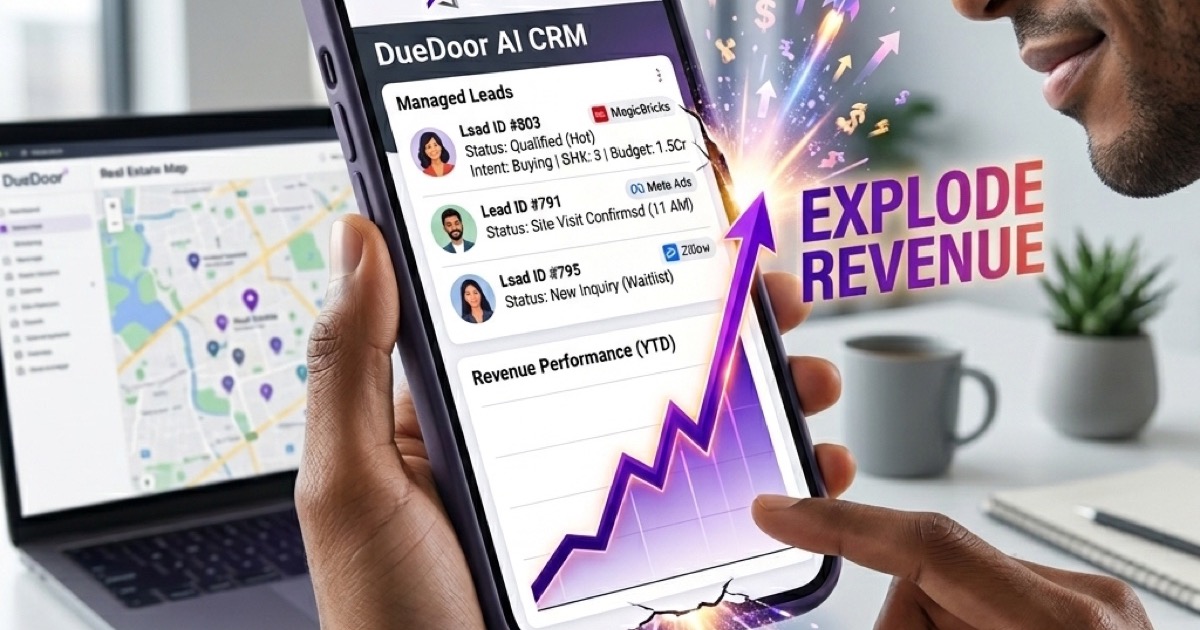
DueDoor is built precisely for this workflow. When a buyer submits an inquiry from any marketplace listing, DueDoor captures the lead automatically, scores it based on engagement signals, and routes it to the right salesperson with the listing context already attached. Your team sees exactly which listing triggered the inquiry, so they can tailor their opening message rather than starting from scratch.
DueDoor's WhatsApp Business API integration means that high-intent leads get an instant automated response - within seconds of submitting the inquiry - while longer follow-up sequences run in the background without manual effort. For teams managing real estate, B2B products, or service listings at scale, this kind of automation is what turns a good-content strategy into a measurable revenue line. If your team is evaluating platforms, comparing affordable CRM solutions for Indian businesses is a useful starting point to understand what you should expect at each price tier.
Response time is one of the strongest predictors of lead conversion. Studies across Indian sales teams consistently show that responding to an inquiry within five minutes is 9 times more effective than responding within an hour. A CRM that automates the first touch while alerting your human team for complex follow-ups is not a luxury for listing-heavy businesses - it is a baseline requirement.
For real estate teams specifically, the combination of listing content quality and lead tracking in a single platform is explored in depth in this guide on the best tools for managing real estate leads. The patterns transfer directly to any marketplace vertical where listings generate inbound interest.
Common Mistakes and How to Fix Them
Even experienced listers repeat the same errors. Recognising them is the fastest way to lift performance without creating new content from scratch.
- Copy-paste from brochures: Brochure language is written for a different medium and a different moment in the buyer journey. Rewrite for the specific portal and the specific stage of intent.
- No price or wildly vague price: Price on request adds friction and signals either inflexibility or a price the seller is embarrassed about. Provide a range if not a fixed price.
- Outdated listings left live: A sold property or discontinued product that still appears in search results damages trust. Build a listing audit into your weekly operations - this is also a problem explored in the guide on common issues with property listings.
- No clear next step: End every listing with a direct, single call to action. WhatsApp us for a site visit beats contact us for more information because it is specific and low-friction.
- Ignoring mobile rendering: Over 78% of Indian marketplace traffic is mobile. Preview every listing on a phone before publishing. Long paragraphs that read fine on desktop become walls of text on a 6-inch screen.
- One-and-done publishing: Listings decay. Refresh descriptions every 30 to 60 days, update photos seasonally, and revise headlines based on what your CRM data shows about which listings are generating the best leads.
DueDoor flags listings that have gone stale or that are receiving high views but low inquiries - a signal that the content needs attention. This closes the loop between content creation and conversion data, so your team spends time improving listings that are almost working rather than guessing where to focus.
Ready to turn your marketplace listings into a consistent lead engine? DueDoor connects your listings, your leads, and your sales team in one AI-powered platform built for Indian SMBs. Start your free trial on the DueDoor dashboard and see how automated lead capture and WhatsApp follow-up can transform your listing performance within the first week.
Frequently Asked Questions
What makes a marketplace listing content engaging?
Engaging listing content combines a benefit-led headline, specific and honest descriptions, high-quality visuals, and a single clear call to action. It answers the buyer top questions before they have to ask, reducing friction and increasing inquiry quality.
How long should a listing description be?
For most Indian marketplaces, 150 to 300 words is the optimal range for a listing description. This is long enough to cover key benefits, specifications, and an objection or two, but short enough to hold attention on mobile. B2B product listings for complex items can run up to 500 words if the buyer needs technical detail to make a decision.
How many photos should I include in a listing?
Eight to twelve photos is the sweet spot for most listing categories. Lead with your strongest image, follow with supporting detail shots, and include at least one contextual photo that shows the product or property in use. For real estate, a short video walkthrough added alongside the photos consistently improves inquiry rates by 30 to 45%.
Should I include pricing in my listing content?
Yes, always include at least a price range. Listings without any pricing signal force buyers to take an extra step, and most will not bother. If you cannot list a fixed price, use phrases like starting from Rs 45,000 or negotiable between Rs 80L and Rs 95L to set expectations and attract serious inquiries.
How does a CRM help with listing content performance?
A CRM like DueDoor tracks which listings generate the most inquiries, how quickly leads are responded to, and how many convert into sales. This data shows you exactly which content elements are working so you can replicate them, and flags underperforming listings so you can improve them before they go stale.
Every lead gets an instant, qualified reply — even at 3 AM
DueDoor's AI reads the inbound WhatsApp, understands pricing/demo/support intent, replies with the right answer, and books the meeting — all in under 4 seconds. No human lifts a finger until the call itself.
- AI understands Hindi, Tamil, Telugu, Marathi, English
- Qualifies budget, team size, timeline automatically
- Books into your actual Google/Outlook calendar
- Escalates to a human only when the AI isn't 95%+ sure
WhatsApp AI
Auto-reply, drip sequences, AI qualification — 24/7.
Leads & Pipeline
Smart lead scoring with auto-routing to your team.
Email Marketing
Personalized AI emails that actually get opened.
Meta Ads AI
One-click campaigns optimized by AI daily.
SEO Engine
Content + ranking on autopilot. Like this page.
LinkedIn (PhewDo)
Outreach + replies handled end-to-end.
References & further reading
- Online marketplace — Wikipedia
- Shopify (official)
- Online advertising — Wikipedia
- Marketing — Wikipedia
- Digital marketing — Wikipedia