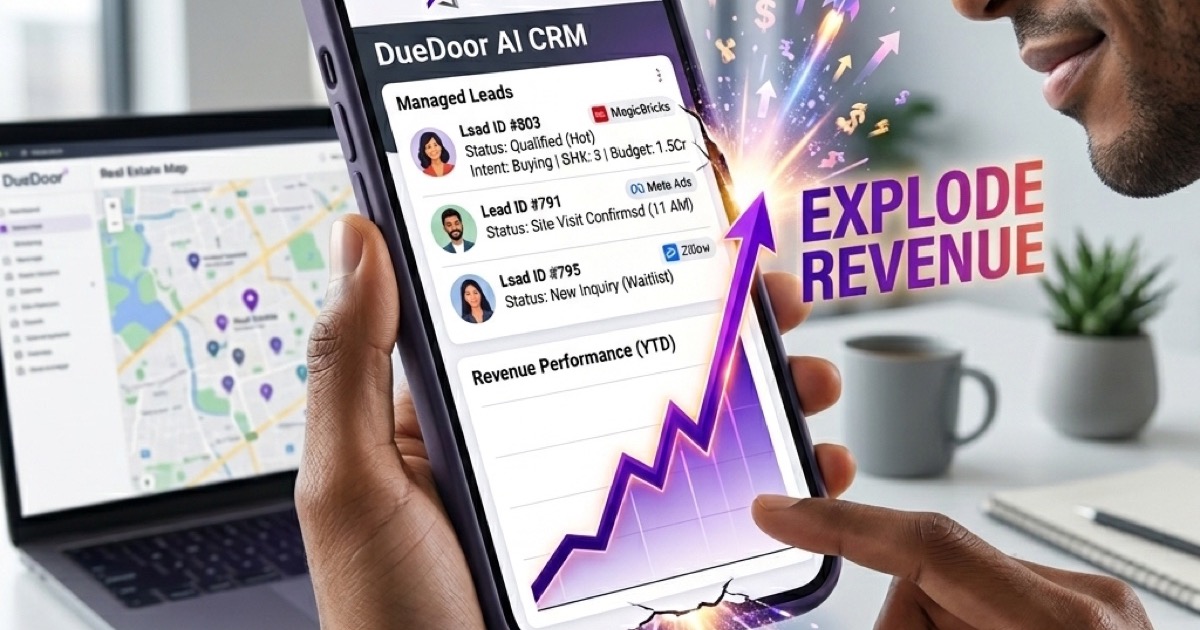
Success in real estate listings is measured through a combination of listing visibility metrics (impressions, clicks), lead quality indicators (inquiry-to-site-visit ratio, qualification rate), and conversion data (site visits to offers, average days on market). Tracking these consistently inside a CRM gives agents a clear, actionable picture of what is working.
Most real estate agents in India pour hours into crafting property listings, uploading photos, writing descriptions, and syncing across portals, but then rely on gut feel to judge whether those listings are actually performing. In a market where buyer attention is fragmented across MagicBricks, 99acres, Housing.com, WhatsApp groups, and Instagram Reels, gut feel is simply not enough. You need hard numbers.
Measuring success in real estate listings is not about vanity metrics like page views. It is about connecting each listing to a pipeline outcome: qualified inquiries, site visits booked, offers received, and deals closed. When you build that chain of measurement, you stop guessing which listings to fix and start making precise, profitable decisions. This guide walks you through exactly how to do that.
Why Measuring Listing Success Matters
Real estate is a high-stakes, low-frequency purchase. A single listing can sit live for 30 to 180 days, accumulating data the entire time. Every day that data goes unread is a day you could have tweaked the headline, added a floor-plan video, or adjusted the price band to match current buyer sentiment. Agents who measure consistently outperform those who do not, and the gap is widening as portals become more algorithm-driven.
Consider this: a listing that gets 800 impressions but only 4 inquiries has a 0.5% click-to-inquiry rate. A competitor listing in the same locality with 600 impressions and 18 inquiries has a 3% rate. The second agent is not lucky, they have optimised their listing based on what the data told them. Measurement is the foundation of that optimisation.
Key reasons to measure listing success:
- Identify underperforming listings before the owner asks why there are no calls
- Justify pricing adjustments with data, not emotion
- Prove ROI on paid portal boosts and featured placements
- Build a repeatable playbook that new team members can follow
- Win more mandates by showing prospective sellers your performance dashboard
Core Visibility Metrics to Track
Visibility metrics sit at the top of your listing funnel. They tell you how many people are seeing your property and whether they find it interesting enough to click through for more details.
Impressions
Impressions count how many times your listing appeared in a search result or feed. High impressions with low clicks usually signal a weak title, uncompetitive price, or a lead photo that does not stand out. Most major portals expose this in their seller dashboard.
Click-Through Rate (CTR)
CTR divides clicks by impressions. A healthy CTR for residential listings in Tier 1 Indian cities typically sits between 2% and 5%. Below 2% means your listing card (thumbnail, price, headline) needs work. Above 5% is excellent and usually indicates a combination of competitive pricing and a compelling hero image.
Listing Page Dwell Time
Some portals expose average time spent on a listing page. Buyers who spend more than 90 seconds are reading carefully, examining photos, and often considering an inquiry. Low dwell time despite high CTR suggests your description, photos, or floor plans are not delivering on the promise of the headline.
"The agents winning in 2026 are not those with the most listings. They are the ones who know exactly which listing to fix on Monday morning because they spent 20 minutes with their data on Friday afternoon."
Lead Quality Indicators
Not all inquiries are equal. A WhatsApp message that says "price?" is very different from a buyer who asks about possession date, parking allocation, and loan eligibility. Lead quality indicators help you separate the serious from the casual.
Key quality signals to score:
- Budget match: Is the buyer's stated budget within 10% of the listing price?
- Timeline: Are they looking to move within 3 months, or "just exploring"?
- Financing status: Pre-approved buyers close 2x faster than those still figuring out home loans
- Decision stage: First inquiry, or have they already visited 5 other properties?
- Channel: WhatsApp leads from a feature listing tend to be warmer than generic email form fills
You can capture all of this in a simple qualification script delivered over WhatsApp or a short call. The goal is to score each lead within 24 hours of first contact so your follow-up energy goes to the right people. For a deeper look at this process, explore the best tools for managing real estate leads that automate lead scoring and qualification.
Conversion and Pipeline KPIs
Conversion KPIs connect listing activity to actual revenue. These are the numbers your broker-owner or investor cares about most.
| KPI | What It Measures | Healthy Benchmark (India, 2026) |
|---|---|---|
| Inquiry-to-Site-Visit Rate | % of inquiries that become a scheduled site visit | 20% to 35% |
| Site Visit-to-Offer Rate | % of site visits that result in a formal offer | 10% to 20% |
| Offer-to-Close Rate | % of offers that reach registration/possession | 60% to 80% |
| Average Days on Market (DOM) | Days from listing activation to accepted offer | 45 to 90 days (residential) |
| List-to-Sale Price Ratio | Final sale price as % of original listing price | 95% to 102% in active micro-markets |
Days on Market deserves special attention. When a listing crosses 90 days without an offer, the market has given you clear feedback. Either the price is wrong, the listing quality is poor, or the property has an unaddressed objection (legal issue, facing direction, floor, etc.). Treating DOM as a lagging indicator rather than an early warning sign is one of the most common mistakes in real estate listings.
Benchmarking Your Listings Against the Market
Individual metrics only tell half the story. You need context. A 25-day DOM sounds great until you realise the locality average is 18 days and you are actually underperforming. Benchmarking puts your numbers into competitive perspective.
How to build a benchmarking baseline:
- Pull 90-day sold data from your primary portal (most offer a "recently sold" filter)
- Segment by property type (2BHK, 3BHK, villa, plot), locality, and price band
- Calculate average DOM, average price per sq ft, and average inquiry count per listing for each segment
- Compare your active listings against these segment averages monthly
For teams managing 20 or more listings simultaneously, this manual process quickly becomes unmanageable. That is where dedicated listing management software built for India adds serious value, automating the data aggregation and surfacing outliers automatically.
Tools and CRM for Accurate Tracking
Spreadsheets work when you have 5 listings. At 15 or more, you need a proper system. A good real estate CRM should capture portal inquiry data, track each lead through the pipeline, log all touchpoints (WhatsApp, call, site visit), and surface conversion rates by listing.
DueDoor is built specifically for this kind of structured tracking. Its AI-powered Growth CRM connects inquiry data from WhatsApp and web forms directly to a visual sales pipeline, so you can see in real time how many inquiries each listing has generated, which stage each lead is at, and where follow-ups are stalling. For agents comparing options, there is a solid breakdown of affordable CRM solutions for Indian businesses that covers what to look for and what to avoid.
Beyond the CRM, your measurement stack for real estate listings typically includes:
- Portal analytics dashboards for impressions, CTR, and inquiry source
- WhatsApp Business API for tracking open rates and response times on broadcast follow-ups
- Google Analytics or similar if you host listings on your own website
- A shared team calendar to log site visits and outcomes against specific listings
DueDoor's WhatsApp automation layer is particularly useful here. When a new inquiry lands, an automated qualification sequence fires over WhatsApp, scores the response, and moves the lead to the right pipeline stage, all without manual intervention. You get clean, consistent data every time rather than the patchy records that come from manual note-taking.
Common Measurement Mistakes to Avoid
Even agents who track metrics regularly fall into patterns that distort their data and lead to bad decisions. Knowing these pitfalls in advance will save you weeks of chasing false signals.
Mistake 1: Counting all inquiries equally. A portal that sends 50 "price check" bot-style leads is not better than one that sends 12 pre-qualified buyers. Always segment inquiries by quality tier before drawing conclusions.
Mistake 2: Ignoring the source attribution problem. Many buyers see a listing on one portal, research on another, and call via a third. Without UTM tagging or a CRM that asks "how did you hear about us?", you will misallocate your portal spend. The common issues with property listings article covers attribution challenges in detail.
Mistake 3: Measuring activity instead of outcomes. The number of listing updates you made this week is an activity metric. The number of qualified site visits you booked is an outcome metric. Focus your review time on outcomes.
Mistake 4: Reviewing data monthly instead of weekly. A listing can burn through its peak visibility window in 7 to 10 days on most portals. Monthly reviews mean you are always reacting to stale data. Weekly is the minimum cadence for active listings.
Building a Weekly Review Cadence
Measurement without action is just data collection. The goal is to build a short, structured weekly habit that turns your numbers into specific improvements.
A practical 30-minute Friday review looks like this:
- Minutes 1-5: Pull impressions and CTR for all active listings. Flag any with CTR below 1.5%.
- Minutes 6-15: Review new inquiries from the week. Score each one and move stale leads to the appropriate pipeline stage in your CRM.
- Minutes 16-22: Check DOM for all listings. Any listing crossing a 30-day or 60-day milestone triggers a specific action: price review at 30 days, photo refresh or description rewrite at 60 days.
- Minutes 23-28: Review your site visit log. Calculate this week's inquiry-to-visit conversion. If it dropped, identify which listings are dragging it down.
- Minutes 29-30: Write three specific action items for next week. Pin them somewhere visible.
This cadence, combined with the right tools, is what separates high-performing agencies from average ones. For a broader look at how measurement feeds into your full marketing approach, the guide on effective marketing tools for small businesses offers complementary tactics that reinforce your listing strategy.
If you are ready to move from manual tracking to a system that does the measurement work for you automatically, get started with DueDoor's AI Growth CRM. Connect your WhatsApp, web forms, and listing inquiries into one pipeline view, and turn your listing data into a consistent source of closed deals.
Frequently Asked Questions
What is the most important KPI for a real estate listing?
The inquiry-to-site-visit conversion rate is arguably the most actionable single KPI because it directly measures whether your listing is attracting genuinely interested buyers rather than casual browsers. Pair it with days on market for a complete picture of listing health.
How often should I review my real estate listing metrics?
Weekly is the minimum recommended cadence for active listings. Most property portals give new listings a visibility boost in the first 7 to 10 days, so waiting a full month to review means missing the window to optimise during peak exposure. A 30-minute Friday review is sufficient for most agents.
What is a good click-through rate for a property listing in India?
In Tier 1 Indian cities, a CTR of 2% to 5% on portal search results is considered healthy for residential listings in 2026. Below 2% suggests your listing thumbnail, headline, or price is not competitive. Above 5% usually indicates a well-priced listing with a strong hero image.
How can a CRM help me measure real estate listing success?
A CRM connects every inquiry to a listing source and tracks it through each pipeline stage, giving you clean conversion rates from first contact to closed deal. Tools like DueDoor automate inquiry capture from WhatsApp and web forms, eliminating the manual data entry that causes gaps in spreadsheet-based tracking.
When should I reduce the price of a listing that is not performing?
If a listing has strong impressions but very few inquiries (CTR below 1%) after 14 days, the price is likely the barrier. If it has good inquiries but no site visits after 21 to 30 days, a price review combined with a description refresh is a reasonable next step. Always compare against recent sold prices in the same micro-market before deciding on the adjustment amount.
Every lead gets an instant, qualified reply — even at 3 AM
DueDoor's AI reads the inbound WhatsApp, understands pricing/demo/support intent, replies with the right answer, and books the meeting — all in under 4 seconds. No human lifts a finger until the call itself.
- AI understands Hindi, Tamil, Telugu, Marathi, English
- Qualifies budget, team size, timeline automatically
- Books into your actual Google/Outlook calendar
- Escalates to a human only when the AI isn't 95%+ sure
WhatsApp AI
Auto-reply, drip sequences, AI qualification — 24/7.
Leads & Pipeline
Smart lead scoring with auto-routing to your team.
Email Marketing
Personalized AI emails that actually get opened.
Meta Ads AI
One-click campaigns optimized by AI daily.
SEO Engine
Content + ranking on autopilot. Like this page.
LinkedIn (PhewDo)
Outreach + replies handled end-to-end.
References & further reading
- Online marketplace — Wikipedia
- Shopify (official)
- Online advertising — Wikipedia
- Marketing — Wikipedia
- Digital marketing — Wikipedia