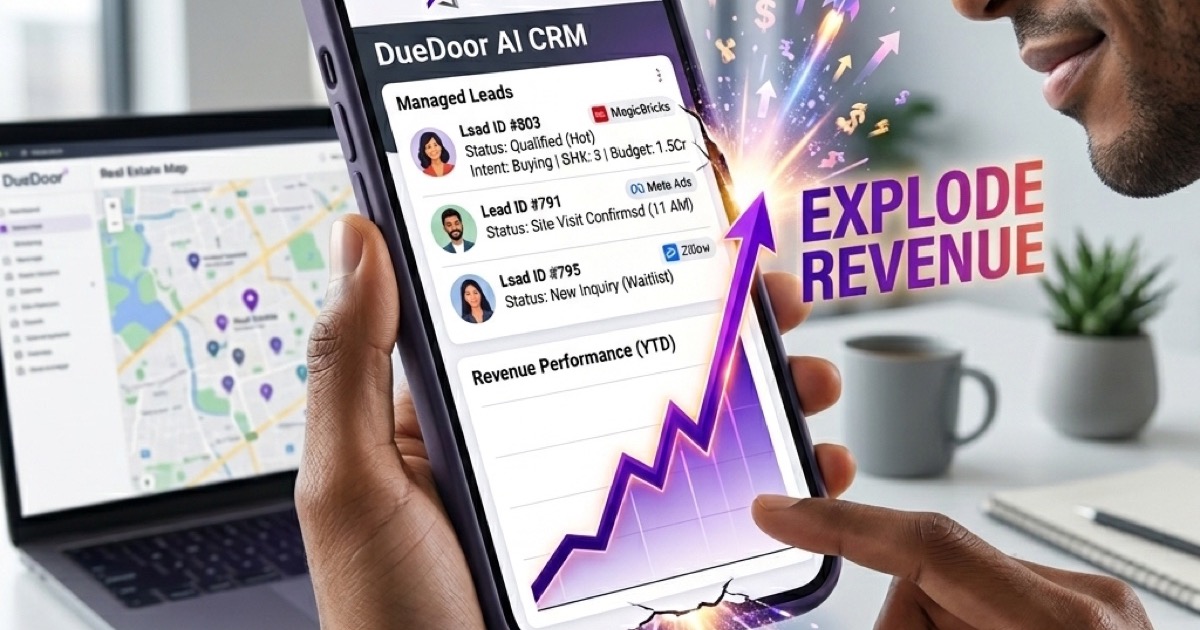
To choose the right CRM for your sales team, match your team size and sales process to a platform that offers pipeline visibility, AI automation, and seamless integrations with channels you already use like WhatsApp, email, or LinkedIn.
Picking a CRM feels deceptively simple until your sales team is six months in, contacts are scattered across spreadsheets, WhatsApp threads, and half-remembered call notes, and nobody is actually using the tool you paid for. The wrong CRM does not just waste money. It creates friction at every step of the sales cycle, from the first lead inquiry to the final payment link.
In 2026, the bar for what a modern CRM must do has shifted dramatically. Indian SMBs, real estate teams, B2B software companies, and field sales organizations all have different workflows, but they share one common requirement: the CRM has to match the way they actually sell, not force them to adapt to a rigid foreign process. This guide walks you through every dimension of that decision, with honest comparisons, practical checklists, and the questions most buyers forget to ask.
Why Your CRM Choice Directly Affects Revenue
A CRM is not a filing cabinet for contact data. It is the operating system for your revenue function. When it works well, every salesperson knows exactly which leads to call today, which deals are at risk, and which follow-ups have gone cold for too long. When it works poorly, reps spend 40 minutes a day logging activities they resent, managers pull reports that are always stale, and high-intent leads fall through the cracks because nobody got a timely reminder.
Research from multiple sales performance studies in 2026 consistently shows that teams using a well-implemented CRM close 3.2 times more pipeline than those relying on manual tracking. The caveat is the phrase well-implemented. A poorly chosen CRM that nobody trusts produces worse outcomes than a shared spreadsheet, because at least the spreadsheet does not give false confidence about pipeline health. The stakes are high enough that getting this decision right deserves serious time and structure.
Define Your Sales Process Before Evaluating Tools
The most common mistake buyers make is opening a vendor comparison website before they have documented their own process. Before you look at a single CRM demo, answer these questions about how your team actually works today:
- Where do leads come from? Are they inbound form fills, outbound WhatsApp campaigns, LinkedIn connection requests, referrals, or walk-ins?
- How many stages does a deal go through? A two-call close needs different pipeline management than a six-week enterprise cycle with multiple stakeholders.
- Who does the follow-up? A solo founder closing deals personally needs very different automation than a team of eight SDRs feeding two closers.
- What does your team use for communication today? If your buyers primarily respond on WhatsApp, a CRM that treats email as the main channel will always feel misaligned.
- What data do you genuinely act on? If your manager never opens the activity report, do not pay extra for a CRM that generates beautiful activity reports.
Write the answers down. They become your evaluation scorecard, not the vendor's feature list. For Indian field sales teams in sectors like real estate or financial services, the answers often point toward mobile-first tools with strong WhatsApp integration, which rules out a surprising number of well-known Western platforms.
Must-Have CRM Features for Sales Teams in 2026
Once you have mapped your process, translate it into a prioritized feature list. Below are the categories every evaluation should include, ranked from foundational to strategic:
- Contact and deal management: Clean, searchable records with custom fields, duplicate detection, and clear ownership. This sounds obvious, but many CRMs still make basic tasks like bulk reassignment or tag-based filtering unnecessarily complex.
- Pipeline visualization: A Kanban board or stage view that lets reps and managers see deal health at a glance. Velocity metrics showing average time in each stage are a major advantage.
- Activity tracking and reminders: Automated follow-up nudges so nothing goes cold by accident. The best CRMs in 2026 send these proactively based on deal inactivity, not just manual calendar entries.
- Mobile experience: For Indian field sales teams, this is non-negotiable. A CRM that is clunky on Android is a CRM that will not be used outside the office.
- Reporting and forecasting: Conversion rates by stage, revenue forecast by close date, team leaderboards, and source attribution. If you cannot measure it, you cannot improve it.
For a deeper breakdown of the features most relevant to Indian businesses, the guide on best CRM options for small businesses in India covers local pricing, regional integrations, and the nuances that global platforms often miss.
AI and Automation: The New Non-Negotiables
In 2026, any serious CRM evaluation must include an honest assessment of AI and automation capabilities. This is no longer a premium add-on for large enterprises. It is a baseline expectation for any team that wants to compete without proportionally growing headcount.
The most impactful AI features to look for include lead scoring (which prioritizes your hottest prospects based on behavior signals), conversation summaries (which save reps from reading long threads before a call), and predictive follow-up timing (which suggests the best moment to re-engage a cold lead). Beyond AI, automation rules should let your team set up sequences like: if a lead opens a proposal but does not respond in 48 hours, send a WhatsApp message and create a task for the assigned rep.
The test of a good CRM automation is whether your team keeps using it when the novelty wears off. Build automations that save five minutes on tasks your reps do twenty times a day, and adoption rates stay high for years.
DueDoor's AI-powered Growth CRM was built with exactly this principle, embedding automation at the workflow level rather than burying it in an advanced settings menu. For sales teams exploring how AI changes the collaboration and pipeline dynamics inside a CRM, the piece on AI-driven solutions for sales team collaboration covers the organizational impact in detail. And for teams specifically looking to improve lead conversion rates using AI signals, the resource on AI tools for lead conversion is worth reading before your next demo call.
CRM Feature Comparison: What to Look For
Not all CRMs are built for the same buyer. The table below summarizes the key dimensions across different categories of tools, to help you quickly identify where each type of platform is strong and where it typically falls short.
| Dimension | Global Enterprise CRM | SMB-Focused CRM | AI-Native Growth CRM |
|---|---|---|---|
| Setup time | Weeks to months | 1 to 3 days | Under 1 day |
| WhatsApp integration | Third-party only | Limited or add-on | Native, two-way |
| AI lead scoring | Premium tier only | Rarely available | Built-in baseline |
| Mobile experience | Functional but heavy | Good | Optimized for field use |
| Rupee pricing | Usually USD billed | INR available | INR with local support |
| LinkedIn outreach | Via Zapier or plugin | Not typical | Native or deep integration |
| Onboarding support | Self-serve + paid CSM | Chat support | Hands-on for SMBs |
The right column describes what DueDoor delivers as a purpose-built AI Growth CRM for Indian and emerging-market sales teams. That said, the right choice depends entirely on your specific answers from the process-mapping exercise above. A six-person real estate team has very different needs from a 40-person B2B SaaS sales floor.
Integrations That Actually Matter for Indian Sales Teams
Integrations are where most CRM evaluations go wrong. Buyers get excited about a long list of supported apps without asking whether those apps are the ones their team actually uses. For Indian sales teams in 2026, the integrations that drive the most daily value are:
- WhatsApp Business API: Two-way messaging inside the CRM, with template broadcasts, auto-replies, and conversation tracking linked to deal records. For Indian SMBs, WhatsApp is often where more than 70% of prospect conversations happen. A CRM that forces you to switch context to WhatsApp Web constantly is a CRM that will have gaps in its deal history. If your team is running WhatsApp campaigns, understanding how to analyze WhatsApp marketing data inside your CRM can unlock serious performance improvements.
- LinkedIn: For B2B teams, LinkedIn connection requests, messages, and profile enrichment should flow directly into CRM records without manual copy-paste.
- Google Workspace and Microsoft 365: Email sync, calendar integration for meeting booking, and Drive links in deal records are baseline requirements.
- Razorpay or payment links: For teams that close deals and collect payments in the same motion, CRM-to-payment integration eliminates the awkward handoff to a finance step.
- Calling and AI meeting notes: Native dialers or integrations with tools that auto-transcribe calls and attach summaries to deal records save hours per week per rep.
Real estate sales teams have additional integration requirements around property listings, site visit scheduling, and booking management. The breakdown of best CRM features for Indian real estate covers those specific needs, including how automation changes the follow-up cadence after a site visit inquiry.
Common Mistakes Teams Make When Choosing a CRM
After working with hundreds of Indian SMB sales teams, a few patterns emerge consistently in failed CRM implementations. Avoiding these saves months of frustration:
- Buying for the demo, not for daily use. CRM demos are designed to impress. Ask vendors to show you how a rep logs an outbound WhatsApp conversation at 9 PM from a phone, or how a manager changes pipeline stage ownership for 30 deals at once. If those workflows are painful in the demo, they will be abandoned in real life.
- Over-customizing before validating the baseline. Many teams spend weeks building custom fields, workflows, and reports before a single deal goes through the system. Start with the defaults, run your first ten deals through them, and only customize what causes actual friction.
- Ignoring adoption signals in the trial period. If your highest-performing rep stops using the CRM after week two of the trial, that is a critical data point. Top performers have the highest opportunity cost for wasted time. Their resistance is usually a signal about UX, not about attitude.
- Choosing the cheapest tool without accounting for hidden costs. Many low-priced CRMs charge extra for WhatsApp integration, API access, additional users, or data exports. Model the true annual cost at your expected user count and feature set before comparing sticker prices.
Your Final Decision Checklist
Before you make your final call, run through this checklist. If you cannot answer yes to the majority of these, go back for one more round of questions with the vendor or your internal team:
- Does the CRM match the primary channels where your prospects actually engage (WhatsApp, email, phone, LinkedIn)?
- Can your entire team be onboarded and using the tool in under a week?
- Does the mobile app work smoothly on the devices your field reps actually carry?
- Are the automation and AI features available on the plan you can afford, not only on the enterprise tier?
- Can you export all your data cleanly if you decide to switch in 18 months?
- Does the vendor have local support in India, or at minimum an India-aware product team that understands WhatsApp-first and rupee-denominated workflows?
- Have you run at least five real deals through the tool during the trial, not just explored the interface?
Choosing well the first time saves not just money but the organizational momentum lost when a CRM rollout fails and teams retreat to spreadsheets and personal WhatsApp groups. The best CRM is the one your team trusts and uses every single day, not the one with the most impressive slide deck.
If you are ready to see what an AI-native CRM built for Indian sales teams looks like in practice, start your DueDoor free trial today and run your first pipeline in under an hour. No months-long implementation, no enterprise contract, just a modern sales system that works the way your team already works.
Frequently Asked Questions
What is the most important factor when choosing a CRM for a small sales team?
Ease of daily use beats feature count every time for small teams. A CRM with fewer features that every rep actually logs activities in will outperform a powerful platform that collects dust. Prioritize mobile usability, fast data entry, and automation that removes repetitive tasks.
Should Indian SMBs use a global CRM or an India-specific one?
It depends on your channel mix. If your team relies heavily on WhatsApp and Razorpay, an India-aware CRM with native integrations for those tools will reduce friction significantly compared to a global platform that treats them as third-party add-ons. Rupee billing and local support also matter for long-term vendor relationships.
How long does a typical CRM implementation take for a 10-person sales team?
A modern SMB-focused CRM should be live and usable in one to three days for a team of ten. If a vendor tells you to budget four to six weeks for a team your size, that is a sign the product was designed for enterprise deployments and will likely require ongoing admin overhead.
Do I need AI features in my CRM if my team is small?
Yes, especially for small teams where every rep carries a large number of leads. AI lead scoring and follow-up reminders prevent high-intent prospects from going cold simply because a rep was busy that week. The ROI of AI features is actually higher per head for small teams than for large ones.
What is the difference between a CRM and a sales automation tool?
A CRM is the system of record for your contacts, deals, and pipeline. A sales automation tool executes sequences like email drips, WhatsApp follow-ups, or task creation based on rules. In 2026, the best CRMs combine both functions natively so teams do not manage two separate platforms for the same sales workflow.
Every lead gets an instant, qualified reply — even at 3 AM
DueDoor's AI reads the inbound WhatsApp, understands pricing/demo/support intent, replies with the right answer, and books the meeting — all in under 4 seconds. No human lifts a finger until the call itself.
- AI understands Hindi, Tamil, Telugu, Marathi, English
- Qualifies budget, team size, timeline automatically
- Books into your actual Google/Outlook calendar
- Escalates to a human only when the AI isn't 95%+ sure
WhatsApp AI
Auto-reply, drip sequences, AI qualification — 24/7.
Leads & Pipeline
Smart lead scoring with auto-routing to your team.
Email Marketing
Personalized AI emails that actually get opened.
Meta Ads AI
One-click campaigns optimized by AI daily.
SEO Engine
Content + ranking on autopilot. Like this page.
LinkedIn (PhewDo)
Outreach + replies handled end-to-end.
References & further reading
- Artificial intelligence — Wikipedia
- Harvard Business Review — Sales
- Sales — Wikipedia
- Customer relationship management — Wikipedia
- Marketing — Wikipedia