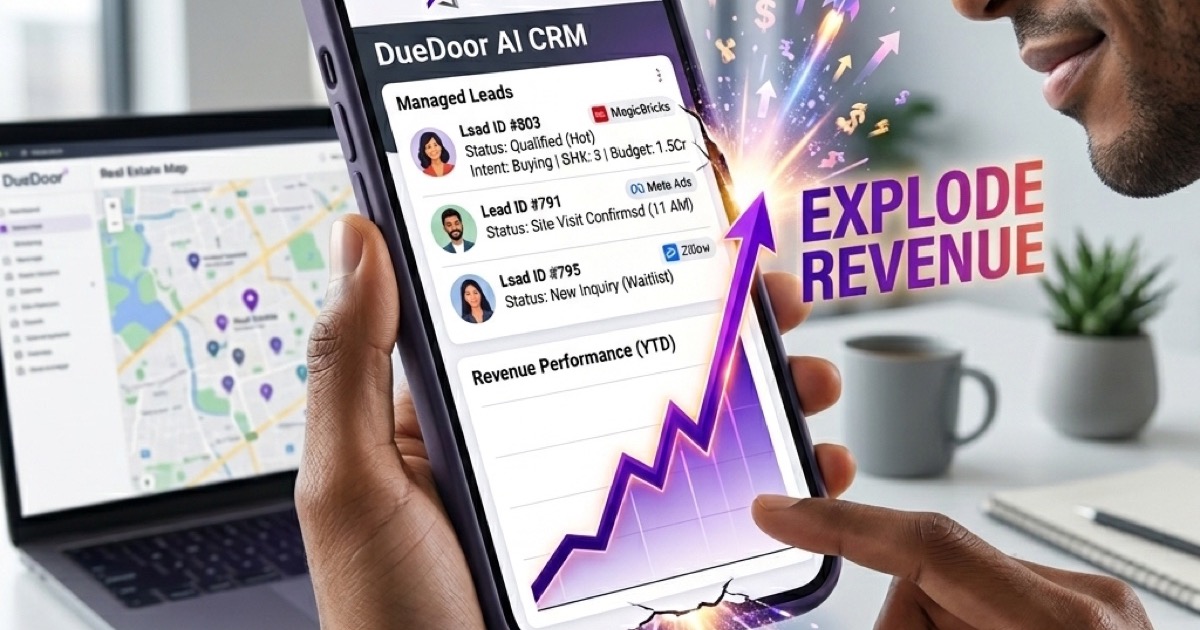
To set up WhatsApp for business sales, create a WhatsApp Business account, configure your profile and catalog, connect to the WhatsApp Business API for automation, and integrate it with your CRM to track and convert leads at scale.
WhatsApp is where Indian buyers actually are. Over 500 million Indians use it daily, and the average message is opened within four minutes of delivery. For sales teams chasing the fastest path from prospect to payment, that is not a statistic to ignore. Whether you run a real estate agency, a SaaS startup, or an FMCG distributor, WhatsApp has quietly become the highest-converting sales channel available to small and mid-size businesses in 2026.
Yet most businesses still treat WhatsApp as a personal chat tool, manually forwarding the same pitch to every lead and hoping someone replies. That approach breaks the moment your pipeline grows beyond 50 active prospects. This guide walks you through a structured setup that turns WhatsApp into a repeatable, measurable, automatable sales channel, with the right tools and API integrations to match the volume your growth demands.
Why WhatsApp Is a Sales Channel, Not Just Messaging
Email open rates in India hover around 18-22%. Cold call answer rates have fallen below 7% for most B2B verticals. WhatsApp, on the other hand, routinely delivers open rates of 95-98% and reply rates above 35%. Those numbers exist because WhatsApp is the primary communication layer for hundreds of millions of people, not a separate inbox they check once a day.
Beyond raw open rates, the conversational nature of WhatsApp compresses the sales cycle. A prospect who might ignore three email follow-ups will often respond to a well-timed WhatsApp message with a product video or a short voice note. Businesses that integrate WhatsApp into their outbound motion alongside AI tools for lead conversion see pipeline velocity improve by 2-3x compared to email-only funnels.
WhatsApp Business App vs API: Which One Do You Need
Meta offers two products and the difference matters enormously for sales operations at scale.
- WhatsApp Business App - Free, works on one phone or desktop, supports a basic catalog, quick replies, and away messages. Ideal for solo founders or teams handling fewer than 30 conversations per day.
- WhatsApp Business API - Cloud-based, multi-agent, supports unlimited contacts, broadcast templates, chatbot automation, and CRM integration. Required the moment you need more than one person managing conversations or you want to automate any part of the follow-up sequence.
For serious sales teams, the API is non-negotiable. The app cannot send bulk notifications, cannot route chats to different agents, and cannot trigger messages based on CRM events like a form submission or a payment failure. If your monthly revenue target is above a few lakhs, build on the API from day one.
Step-by-Step Setup for Business Sales
1. Register a dedicated business number
Use a SIM or virtual number that is not already linked to a personal WhatsApp account. Indian businesses often use a Jio or Airtel postpaid number for reliability. The number becomes your verified business identity, so treat it like a professional email address.
2. Apply for WhatsApp Business API access
Access the API through a Meta Business Solution Provider (BSP). Your BSP handles the onboarding, number verification, and template approvals. The process typically takes 3-7 business days. You will need a verified Meta Business Manager account and a display name that matches your GST-registered business name.
3. Set up your business profile
A complete profile builds trust before the first message. Fill in your business category, description, address, website, and operating hours. Upload a high-resolution logo. Businesses with complete profiles see up to 40% higher response rates because prospects can verify legitimacy before replying.
4. Create your product catalog
If you sell physical products or subscription plans, link a catalog directly to your WhatsApp account. Prospects can browse, share, and inquire about specific items without leaving the chat. This is especially powerful for D2C brands and real estate developers who want to showcase inventory instantly.
5. Connect your API to a platform
Raw API access requires a developer to build the messaging layer. Most businesses use a platform like DueDoor that sits on top of the API and provides a no-code interface for broadcasts, automation flows, agent routing, and analytics. This collapses weeks of engineering work into a single afternoon of configuration.
Automating Follow-Ups and Lead Qualification
Manual follow-up is the silent killer of most sales pipelines. A lead fills in a form at 11 PM on a Sunday. Your sales rep sees it Monday morning. The prospect has already spoken to two competitors. Automation eliminates that gap by triggering a WhatsApp message within seconds of any qualifying event, whether that is a form submission, a demo booking, a cart abandonment, or an inbound WhatsApp keyword.
A well-structured automation sequence for a typical B2B SaaS or services company looks like this:
- Instant acknowledgement with the prospect's name and a specific next step (not a generic "we will get back to you").
- A qualifying question 10 minutes later (budget, timeline, or team size) that routes hot leads to a human and cold leads to a nurture drip.
- A value message at 24 hours - a case study, a product demo video, or a pricing sheet based on the prospect's industry.
- A hard CTA at 48 hours with a one-click calendar link for a demo call.
The qualification step is where AI adds the most leverage. Natural language processing can read a free-text reply, classify intent, extract data like company size or budget range, and update your CRM automatically, with no human involvement until the lead is sales-ready. Pairing this with AI-driven solutions for sales team collaboration means your reps spend their time on warm conversations, not data entry.
Connecting WhatsApp to Your CRM
WhatsApp without CRM integration is a productivity trap. You get conversations but no pipeline visibility, no attribution, and no way to know whether a deal closed because of the second or the fifth follow-up. The integration work is straightforward when you use a platform that treats WhatsApp as a native channel rather than a bolt-on.
At minimum, your CRM integration should cover:
- Auto-creating a lead record when a new WhatsApp conversation starts.
- Logging every inbound and outbound message against the contact record with timestamps.
- Updating deal stage automatically based on reply content or button clicks (e.g., a prospect clicking "Book a Demo" moves them from Lead to Demo Booked).
- Triggering other channel actions - an email follow-up, a LinkedIn connection request, or an internal Slack alert to the account owner.
For Indian SMBs evaluating options, the best CRM features for small businesses in India include WhatsApp-native conversation views, rupee-denominated pipeline reporting, and regional language template support. DueDoor was built with this use case at its core, combining a WhatsApp Business API layer with a full AI CRM so that every conversation and every deal stage lives in one place.
Broadcast Lists, Templates, and Compliance
WhatsApp's template system is both a compliance guardrail and a quality filter. Any outbound message sent to a user who has not messaged you in the last 24 hours must use a pre-approved template. Meta reviews templates for policy compliance before approving them, and approval typically takes 1-4 hours for straightforward business content.
| Template Category | Use Case | Approval Complexity |
|---|---|---|
| Utility | Order confirmations, payment reminders, appointment updates | Low - usually auto-approved |
| Authentication | OTPs, login verifications | Low |
| Marketing | Promotions, product launches, reactivation campaigns | Medium - needs clear opt-in evidence |
| Service | Support follow-ups, survey requests | Low to medium |
On compliance: Indian businesses must honour the DND registry and ensure all WhatsApp contacts have provided explicit opt-in consent. WhatsApp's own quality rating system will flag your number if recipients report your messages as spam, eventually restricting or banning your sending ability. Build your list through genuine opt-ins - website forms, checkout flows, and offline sign-up sheets - not purchased data.
"The businesses that win on WhatsApp are not the ones sending the most messages. They are the ones sending the right message to the right person at the right moment in the buying journey. Volume without relevance gets you banned, not booked."
Measuring WhatsApp Sales Performance
You cannot improve what you do not measure. WhatsApp sales performance should be tracked at two levels: channel metrics (delivery rate, open rate, reply rate, click-through rate on CTAs) and business metrics (leads generated, demos booked, deals closed, revenue influenced). Most teams measure only the first layer and miss the revenue attribution entirely.
Key dashboards to build:
- Template performance - which templates drive the highest reply and CTA click rates, segmented by industry and funnel stage.
- Agent response time - average time from inbound message to first human reply, broken down by agent and shift.
- Conversion funnel - message received to reply to demo booked to closed-won, with drop-off percentages at each step.
- Opt-out rate - rising opt-outs signal message fatigue or poor list quality before Meta flags your account.
Detailed guidance on pulling these numbers and building attribution models is covered in the resource on how to analyze WhatsApp marketing data, which walks through cohort analysis, A/B testing templates, and tying conversation data back to revenue.
Common Mistakes and How to Avoid Them
After watching hundreds of Indian SMBs set up WhatsApp for sales, a handful of mistakes come up repeatedly.
- Using a personal number for business outreach - It looks unprofessional, lacks automation capability, and risks the number being flagged for spam.
- Sending unformatted walls of text - WhatsApp is a conversational medium. Keep messages under 150 words, use line breaks, and lead with the most important point.
- No follow-up sequence - Most sales happen after the third or fourth contact. A single broadcast with no follow-up logic leaves the majority of your pipeline on the table.
- Ignoring working hours - Messages sent at 2 AM feel intrusive and lower reply rates. Schedule broadcasts for 9-11 AM or 4-7 PM in the recipient's time zone.
- Siloed WhatsApp data - If your WhatsApp conversations live only inside the chat platform and never sync to your CRM, your sales managers have no visibility and your follow-up logic breaks the moment a rep goes on leave.
Real estate teams, which rely heavily on relationship-driven selling and in-person visits, face a specific version of this last problem. The best CRM features for Indian real estate include site-visit scheduling directly from WhatsApp, automated location sharing, and post-visit follow-up sequences that bridge the gap between the physical property visit and the digital paper trail.
If you are running a real estate business and want to see how WhatsApp automation fits into a full sales stack, the guide on best sales automation tools for real estate covers the full toolchain from lead capture through site visit to booking confirmation.
Ready to turn WhatsApp into your highest-converting sales channel? DueDoor connects WhatsApp Business API, AI lead qualification, broadcast automation, and a full sales pipeline into one platform built for Indian SMBs. No engineering required - go live in under a day. Start your free DueDoor trial and set up your WhatsApp sales system today.
Frequently Asked Questions
Do I need the WhatsApp Business API or is the free app enough for sales?
The free WhatsApp Business app works for very small teams handling fewer than 30 conversations per day. For anything beyond that, you need the API, which supports multiple agents, broadcast templates, automation workflows, and CRM integration that the app cannot provide.
How long does it take to get WhatsApp Business API access in India?
Approval through a Meta Business Solution Provider typically takes 3-7 business days. You need a verified Meta Business Manager account, a dedicated phone number not linked to an existing WhatsApp account, and a display name matching your registered business name.
Is it legal to broadcast promotional WhatsApp messages to customers in India?
Yes, provided every recipient has given explicit opt-in consent to receive WhatsApp messages from your business. You must also respect DND registrations and provide an easy opt-out option. Purchased contact lists without opt-in evidence violate both Meta policy and Indian telecom regulations.
What types of messages require pre-approved templates on WhatsApp?
Any message sent to a user who has not messaged your business in the last 24 hours must use a Meta-approved template. This includes promotional broadcasts, payment reminders, appointment confirmations, and re-engagement campaigns. Replies within an active 24-hour window can be free-form.
How do I stop WhatsApp from becoming a disorganised pile of chats as the team grows?
Connect WhatsApp to a CRM platform that logs every conversation against a contact record, assigns chats to specific agents, and updates deal stages automatically based on message events. Tools like DueDoor are built for exactly this, giving sales managers full pipeline visibility across every WhatsApp conversation.
Every lead gets an instant, qualified reply — even at 3 AM
DueDoor's AI reads the inbound WhatsApp, understands pricing/demo/support intent, replies with the right answer, and books the meeting — all in under 4 seconds. No human lifts a finger until the call itself.
- AI understands Hindi, Tamil, Telugu, Marathi, English
- Qualifies budget, team size, timeline automatically
- Books into your actual Google/Outlook calendar
- Escalates to a human only when the AI isn't 95%+ sure
WhatsApp AI
Auto-reply, drip sequences, AI qualification — 24/7.
Leads & Pipeline
Smart lead scoring with auto-routing to your team.
Email Marketing
Personalized AI emails that actually get opened.
Meta Ads AI
One-click campaigns optimized by AI daily.
SEO Engine
Content + ranking on autopilot. Like this page.
LinkedIn (PhewDo)
Outreach + replies handled end-to-end.
References & further reading
- Artificial intelligence — Wikipedia
- Harvard Business Review — Sales
- Sales — Wikipedia
- Customer relationship management — Wikipedia
- Marketing — Wikipedia