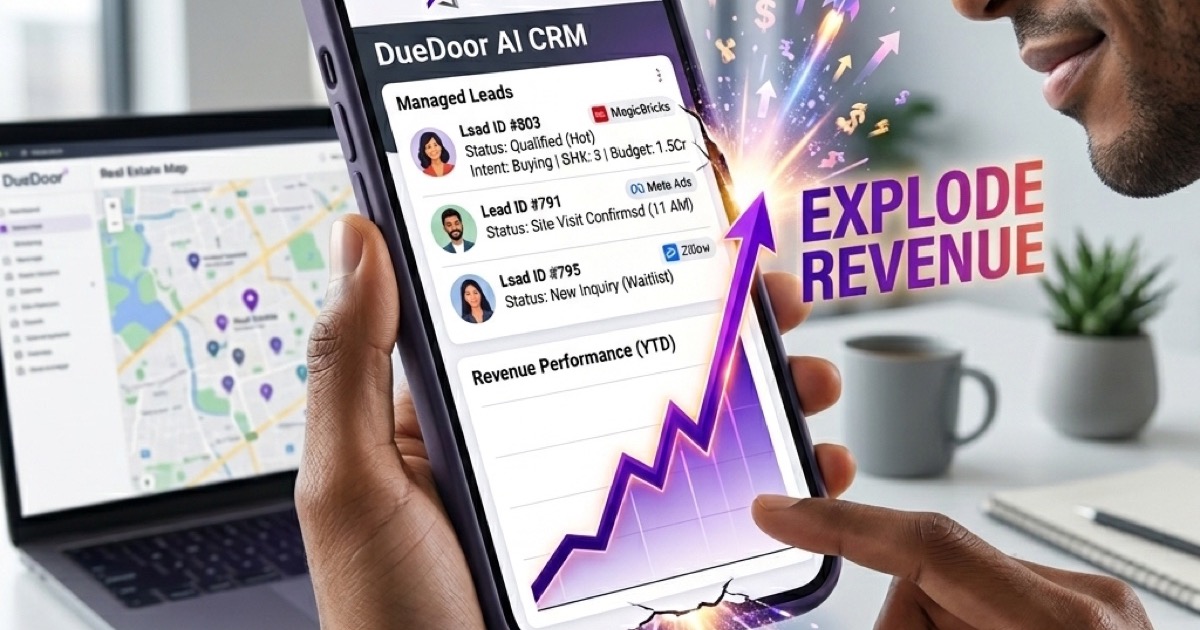
AI customer segmentation uses machine learning to automatically group buyers by behavior, intent, and firmographics so sales teams can personalise outreach at scale. Tools like DueDoor analyse CRM signals in real time to surface which segment each lead belongs to and trigger the right follow-up instantly.
Every sales team has the same core problem: not every lead is equal, yet most teams treat them as if they are. Reps blast the same message to a bootstrapped founder in Pune and a procurement manager at a 500-person firm in Bengaluru, then wonder why conversion rates stagnate. Customer segmentation has always been the theoretical answer, but manual segmentation is slow, expensive, and stale the moment it is finished.
AI changes this completely. Modern machine-learning models can ingest thousands of data signals simultaneously, from browsing behaviour and CRM history to WhatsApp reply patterns and LinkedIn activity, and produce dynamic, self-updating segments that sales teams can act on in minutes rather than months. This guide explains exactly how it works, why it matters for Indian SMBs in particular, and how to build a segmentation engine that feeds your sales pipeline automatically.
What Is AI Customer Segmentation?
AI customer segmentation is the process of using machine learning algorithms to divide a prospect or customer base into groups that share meaningful characteristics, without requiring a data scientist to define every rule by hand. Unlike a spreadsheet filter that groups people by industry or company size alone, an AI model discovers hidden combinations of signals that actually predict purchase likelihood.
A well-trained segmentation model might learn, for instance, that "SaaS founders with fewer than 20 employees who opened three emails but never booked a demo" convert at 4x the rate of a broader "SaaS founder" bucket, and that the right nudge for them is a WhatsApp voice note rather than another cold email. That level of granularity is impossible to craft manually at scale.
Why Traditional Segmentation Fails Sales Teams
Traditional segmentation relies on static rules: industry, geography, company size, or job title. These rules are built once, assigned to a spreadsheet or a CRM filter, and left unchanged for months. The problems are well documented:
- Data goes stale. A company that was a 10-person startup in January may have raised a Series A by April. Static segments miss the signal entirely.
- Rules reflect assumptions, not evidence. When a marketing manager writes the segmentation rules, they encode their own biases, not what the data actually shows about buying behaviour.
- Segments are too broad. Grouping all "retail SMBs in Maharashtra" together ignores the fact that a kirana store owner and a D2C fashion founder have almost nothing in common as buyers.
- No feedback loop. Traditional segments do not automatically update when a campaign underperforms. Someone has to notice, investigate, and rewrite the rules manually.
The result is wasted outreach, low reply rates, and reps spending time on prospects who were never going to convert. AI tools built specifically for lead conversion address each of these failure modes by making segmentation continuous and evidence-driven.
How AI Builds Smarter Segments
AI segmentation models work by ingesting multiple data sources simultaneously and finding statistical clusters among them. The key inputs typically include:
- Firmographic data: Industry, headcount, revenue band, funding stage, and tech stack.
- Behavioural data: Pages visited, emails opened, links clicked, WhatsApp replies, demo attendance, and repeat visits.
- Intent signals: Search queries, review site visits, competitor comparisons, and pricing page views.
- Engagement velocity: How fast a prospect moves through awareness to consideration, which predicts urgency.
- Historical conversion data: Which past customers looked like this prospect before they bought?
Clustering algorithms such as k-means, DBSCAN, or gradient-boosted classifiers group prospects by the combination of these signals rather than any single dimension. The model then labels each cluster with a predicted conversion probability and a recommended next action. Reps receive a prioritised queue instead of a flat list.
"Segmentation is not about putting people in boxes. It is about understanding which conversation to start, at what moment, through which channel. AI gives you that without guesswork."
Segmentation Models Compared
| Segmentation Type | Method | Best For | Limitation |
|---|---|---|---|
| Demographic / Firmographic | Manual rules on static fields | Initial list filtering | No behavioural nuance |
| RFM (Recency, Frequency, Monetary) | Formula-based scoring | Existing customer upsell | Ignores intent signals |
| Behavioural clustering | ML on engagement data | Email and WhatsApp campaigns | Needs sufficient data volume |
| Predictive propensity scoring | Supervised ML on closed-won history | Prioritising active pipeline | Requires clean historical CRM data |
| Dynamic AI segments | Real-time model updates as new signals arrive | Fast-moving markets, high-velocity pipelines | Higher compute, needs integrated data stack |
For most Indian SMBs, starting with behavioural clustering combined with basic firmographic filters delivers strong early results without requiring a mature data warehouse. As the CRM accumulates closed-won history, layering in predictive propensity scoring compounds the gains significantly.
Applying Segments to Sales Outreach
A segment is only valuable if it triggers a different action. Here is how high-performing sales teams translate AI segments into pipeline movement:
- High-intent, high-fit prospects get an immediate personal WhatsApp or LinkedIn message from the account owner, referencing the specific signal that triggered the alert.
- Medium-intent, high-fit prospects enter an automated drip sequence with personalised subject lines drawn from the segment attributes, such as mentioning their industry or recent product category visit.
- High-intent, low-fit prospects receive a lighter-touch nurture sequence to qualify further before a rep invests time.
- Low-intent, low-fit prospects stay in a long-term nurture pool and are re-scored monthly.
This tiered approach ensures that sales team collaboration is built around shared segment data rather than individual rep intuition, which dramatically reduces the "star rep dependency" problem common in smaller sales organisations. When a rep leaves, the segment logic stays.
Channel selection is equally important. Research consistently shows that WhatsApp reply rates in India outperform email by a factor of three or more for SMB audiences. Analysing WhatsApp marketing data at the segment level reveals which message templates, send times, and conversation starters drive the highest engagement for each cluster, creating a compounding advantage over time.
AI Segmentation for Indian SMBs
The Indian SMB market has characteristics that make AI segmentation especially impactful. Buying decisions are often made by the founder or a single director, not a committee, which means the right individual-level signal matters more than account-level scoring. Payment sensitivity is high, so segments need to capture willingness-to-pay signals accurately to avoid sending aggressive pricing to a price-sensitive cluster or underpricing to a premium buyer.
Geographic and linguistic diversity adds further complexity. A prospect in Tamil Nadu may prefer communication in a different register than one in Delhi, and the business context for a textile exporter in Surat differs enormously from a logistics startup in Hyderabad. AI models trained on India-specific conversion data handle these nuances far better than generic Western CRM templates.
Choosing the best CRM for small businesses in India is therefore not just about feature lists. It is about whether the platform can ingest the right data sources (WhatsApp, local directories, GST-linked firmographics) and produce segments that reflect the reality of the Indian buying journey rather than a Silicon Valley playbook.
DueDoor is built specifically for this context. Its AI lead scoring engine ingests WhatsApp engagement, LinkedIn signals, website behaviour, and pipeline history simultaneously, surfacing high-priority segments in a single dashboard view. Indian sales teams using DueDoor report cutting their cost-per-qualified-lead significantly within the first quarter by concentrating outreach on the segments the model identifies as most likely to close.
Tools and Integrations That Make It Work
Effective AI segmentation requires your data stack to be connected. Isolated data sources produce isolated segments that do not reflect the full customer picture. The minimum viable stack for an Indian SMB sales team typically includes:
- A CRM that tracks pipeline stage, deal size, and rep notes
- WhatsApp Business API integration with read-receipt and reply-rate data at the contact level
- Website analytics tied back to named prospects via tracking or form capture
- A LinkedIn outreach log showing connection acceptance rates and message reply rates per prospect
With these four sources unified in one platform, an AI model has enough signal to produce genuinely useful segments. Adding email sequence data, call recording summaries, and intent data from third-party providers can improve accuracy further, but the core four are sufficient to start.
Real estate sales teams, for example, benefit from segmenting by property type interest, budget range, and inquiry-to-site-visit conversion history. The best sales automation tools for real estate integrate these property-specific signals with standard CRM data to build segments that predict which buyer is ready to visit a site this week versus which one is still six months away from a decision.
Getting Started: A Step-by-Step Approach
If you are starting from scratch, here is a practical sequence that avoids common mistakes:
- Step 1 - Audit your existing data. Before choosing a model, map what signals you actually capture consistently. Sparse or inconsistent data produces unreliable segments. Fix data hygiene first.
- Step 2 - Define two or three meaningful segment hypotheses. For example: "Founders of funded SaaS companies who visited our pricing page are more likely to buy than those who only visited the homepage." Use these as your first test cases.
- Step 3 - Run a retrospective validation. Apply your hypothesised segment rules to closed-won and closed-lost deals from the past 12 months. If the hypothesis holds, it is worth automating.
- Step 4 - Choose a platform that updates segments in real time. Batch segmentation that runs weekly or monthly is too slow for a high-velocity SMB pipeline. You need live re-scoring as new signals arrive.
- Step 5 - Build segment-specific playbooks. Define what action each segment triggers: which message template, which channel, which rep, and which SLA for follow-up. Without playbooks, even perfect segments produce inconsistent execution.
- Step 6 - Measure and iterate monthly. Track conversion rate by segment, not just overall pipeline conversion. Segments that consistently underperform need to be re-examined, either because the hypothesis was wrong or because the playbook needs updating.
DueDoor automates steps four and five out of the box. Its segmentation engine continuously re-scores leads as new WhatsApp, LinkedIn, and website signals arrive, and its workflow builder lets you attach a specific outreach sequence to each segment without writing a single line of code. Teams that previously spent three days per quarter manually re-sorting their CRM now get live segment queues that update every few minutes.
Customer segmentation powered by AI is no longer a capability reserved for enterprise companies with large data science teams. Indian SMBs with even a few hundred prospects in their pipeline can deploy it today using platforms built for their scale and context. The teams that do so will carry a structural advantage: they spend their outreach budget and rep time where the data says it will convert, while competitors still spray and pray.
Ready to see what AI-driven segmentation looks like in practice for your sales team? Start your free DueDoor trial and explore the live segment dashboard with your own pipeline data in under ten minutes.
Frequently Asked Questions
What data does an AI customer segmentation model need to work effectively?
At minimum, an AI segmentation model needs firmographic data (industry, company size), behavioural data (emails opened, links clicked, WhatsApp replies), and historical conversion outcomes. The more consistently these signals are captured in your CRM, the more accurate the segments will be.
How is AI segmentation different from a basic CRM filter?
A CRM filter applies rules you define manually based on one or two fields. An AI model discovers combinations of dozens of signals that actually predict conversion, including patterns a human analyst would never think to look for. It also updates automatically as new data arrives, whereas manual filters stay static.
How long does it take to see results from AI customer segmentation?
Most sales teams see measurable improvements in reply rates and qualified-lead volume within four to six weeks of implementing AI segmentation, assuming their CRM data is reasonably clean. The model improves further as it accumulates more closed-won history over the following months.
Is AI segmentation suitable for small Indian businesses with limited data?
Yes, with the right platform. Indian-market CRMs like DueDoor are designed to work with the data volumes typical of SMB pipelines, often a few hundred to a few thousand prospects. You do not need millions of rows to benefit. Even basic behavioural clustering on a small dataset outperforms purely manual segmentation.
Can AI segmentation work across different sales channels like WhatsApp and LinkedIn?
Absolutely. The most effective AI segmentation models are multi-channel by design. They ingest signals from WhatsApp engagement, LinkedIn outreach, email opens, and website visits simultaneously and produce a single unified segment score per prospect. This cross-channel view is more accurate than single-channel scoring because it reflects the full buying journey.
Every lead gets an instant, qualified reply — even at 3 AM
DueDoor's AI reads the inbound WhatsApp, understands pricing/demo/support intent, replies with the right answer, and books the meeting — all in under 4 seconds. No human lifts a finger until the call itself.
- AI understands Hindi, Tamil, Telugu, Marathi, English
- Qualifies budget, team size, timeline automatically
- Books into your actual Google/Outlook calendar
- Escalates to a human only when the AI isn't 95%+ sure
WhatsApp AI
Auto-reply, drip sequences, AI qualification — 24/7.
Leads & Pipeline
Smart lead scoring with auto-routing to your team.
Email Marketing
Personalized AI emails that actually get opened.
Meta Ads AI
One-click campaigns optimized by AI daily.
SEO Engine
Content + ranking on autopilot. Like this page.
LinkedIn (PhewDo)
Outreach + replies handled end-to-end.
References & further reading
- Artificial intelligence — Wikipedia
- Harvard Business Review — Sales
- Sales — Wikipedia
- Customer relationship management — Wikipedia
- Marketing — Wikipedia