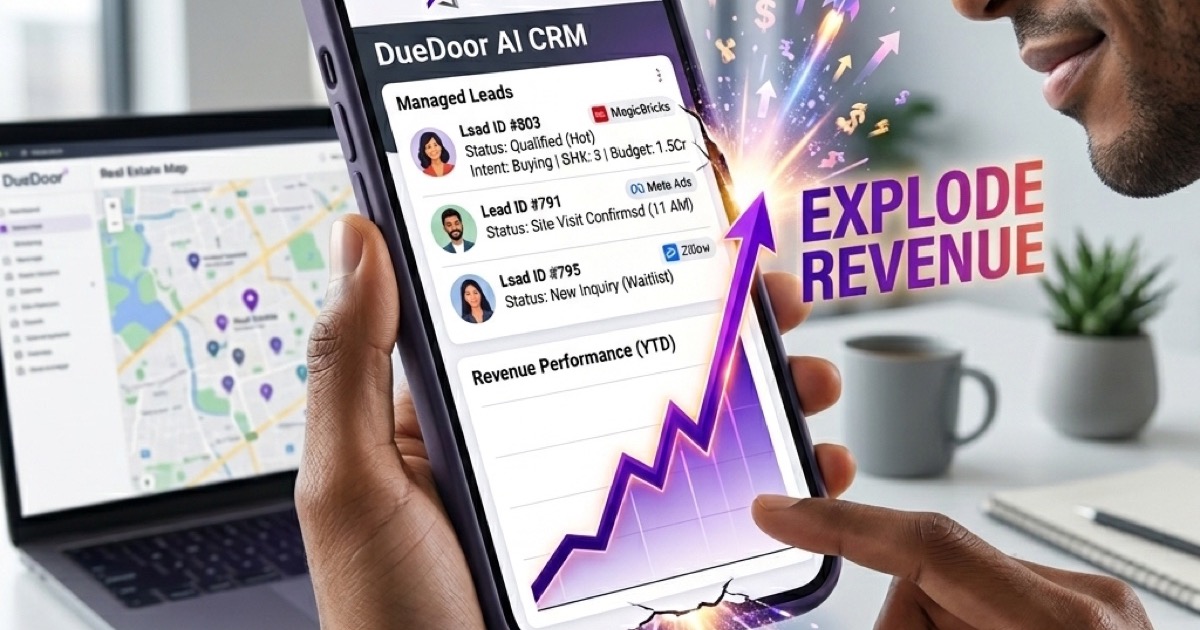
The best CRM for a small business depends on your sales channels, team size, and budget. AI-powered CRMs that combine lead management, WhatsApp automation, and pipeline tracking deliver the fastest ROI for Indian SMBs and growing sales teams.
Choosing a CRM system is one of the most consequential decisions a small business makes. The right platform turns a scattered spreadsheet of contacts into a disciplined, automated pipeline that converts strangers into paying customers, often without a salesperson manually chasing every lead. The wrong one adds overhead, frustrates your team, and collects digital dust within three months.
This comparison cuts through the noise. Whether you run a real estate agency in Pune, a logistics startup in Bengaluru, or a B2B software firm selling to Southeast Asia, the frameworks below will help you identify which CRM system genuinely fits your operation, and why the gap between generic CRMs and AI-native Growth CRMs is widening fast in 2026.
Why CRM Matters for Small Businesses
Small businesses lose the most from disorganized follow-up. A founder with 12 open deals in their WhatsApp inbox, four pending emails, and two LinkedIn conversations has no reliable way to know which prospect is hot, which is cold, and which slipped away last Tuesday. A CRM centralizes this information so that every interaction is logged, every follow-up is scheduled, and no lead falls through the cracks.
The business case is straightforward. According to Salesforce research, CRM adoption lifts sales productivity by an average of 29% and forecast accuracy by 42%. For small teams where each rep carries 40 to 80 accounts, those gains translate directly into revenue. The challenge is that traditional CRMs were built for enterprise sales cycles, not for Indian SMBs juggling WhatsApp, email, calls, and LinkedIn simultaneously.
Key Features to Compare
Not every CRM feature matters equally for a small business. Focus your evaluation on these categories:
- Lead capture and enrichment: Can the CRM pull leads from web forms, LinkedIn, WhatsApp, and inbound calls automatically, and enrich them with firmographic data without manual input?
- Pipeline visualization: Drag-and-drop stage management, deal probability scoring, and stale-deal alerts keep a small team focused on winnable opportunities.
- Communication channels: Native WhatsApp Business API, email sequencing, and LinkedIn outreach in one platform versus juggling five separate tools.
- Automation depth: Rule-based triggers are table stakes. AI-driven follow-up scheduling, sentiment detection, and auto-reply drafts are the differentiator in 2026.
- Reporting and forecasting: Real-time dashboards that show pipeline health, conversion by stage, and revenue at risk without requiring a data analyst.
- Mobile-first experience: Indian sales teams are predominantly mobile. A CRM with a clunky mobile app loses adoption in week two.
- Integration ecosystem: Accounting (Zoho Books, Tally), telephony (Exotel, Knowlarity), and marketing tools (Mailchimp, Brevo) should connect without custom code.
- Onboarding and support: A small business cannot afford a six-month implementation. Look for guided setup, video walkthroughs, and responsive chat support in IST hours.
For a deeper dive into what separates good CRMs from great ones in the Indian context, see this guide on the best CRM features for small businesses in India.
CRM Systems Side-by-Side Comparison
The table below covers the most frequently evaluated platforms in the Indian SMB and global startup market. Pricing is indicative for teams of 3 to 10 users.
| Platform | AI Features | WhatsApp Native | LinkedIn Outreach | Approx. Monthly Cost (INR) | Best For |
|---|---|---|---|---|---|
| DueDoor | AI lead gen, AI calling, AI inbox, auto-scoring | Yes (BSP-level) | Yes (built-in daemon) | From ~3,500 | Indian SMBs, real estate, B2B SaaS |
| Zoho CRM | Zia AI assistant, prediction | Via third-party | No | From ~1,200 | SMBs needing deep Zoho suite integration |
| HubSpot (Starter) | ChatSpot, AI content | Via third-party | No | From ~3,800 | Inbound-focused, content-heavy teams |
| Freshsales | Freddy AI scoring | Via Freshdesk | No | From ~1,600 | Teams already using Freshworks suite |
| Pipedrive | AI deal summary (beta) | No | No | From ~2,000 | Pipeline-visual, simple sales workflows |
| Salesforce Essentials | Einstein AI (limited at tier) | No | No | From ~5,500 | Teams planning to scale to enterprise |
The AI-Powered CRM Advantage
The CRM landscape split sharply in 2025 and 2026 between platforms that bolt AI on as a feature and platforms built with AI as the core operating layer. The difference is visible the moment you log in. A bolt-on AI suggests a follow-up email. An AI-native CRM identifies which of your 200 prospects is most likely to convert this week, drafts a personalized outreach sequence, sends it across WhatsApp and email, logs every reply, and flags the three deals that need human attention, all before your morning tea.
AI lead scoring alone changes how small teams allocate time. Instead of treating every inbound inquiry equally, the system ranks leads by fit (industry, company size, prior engagement) and intent (time on pricing page, email open rate, response speed). Reps spend 80% of their time on the top 20% of prospects.
AI calling, where a voice agent handles initial qualification calls and books meetings directly into a rep's calendar, is the single biggest multiplier for resource-constrained teams. A founder running a 4-person sales operation in Hyderabad can now run outreach at the volume a 15-person team would previously require. For a practical breakdown of how these tools lift conversion, see this overview of AI tools for lead conversion.
"We were manually following up with 60 leads a week across WhatsApp and email. After switching to an AI-native CRM, the system handles 80% of that follow-up automatically and flags the replies that need my attention. Our conversion rate went from 12% to 21% in 90 days." - Founder, B2B SaaS startup, Bengaluru
WhatsApp Integration for Indian SMBs
WhatsApp is not optional for Indian sales teams. With over 500 million active users in India and an open rate above 90%, it is the default communication channel for most business conversations below enterprise level. A CRM that treats WhatsApp as an afterthought, routing messages through a third-party Zap that breaks twice a month, creates more problems than it solves.
What to look for in WhatsApp-native CRM integration:
- Direct Business Solution Provider (BSP) connection, not a fragile webhook relay
- Template message management with Meta approval status visible inside the CRM
- Two-way conversation threads linked to the prospect record
- Broadcast campaigns with segmentation by pipeline stage, industry, or custom tag
- Automated drip sequences triggered by deal stage changes
- Analytics on message delivery, open, and response rates per campaign
Understanding what your WhatsApp data is actually telling you about prospect behavior is a skill most small teams have not yet developed. This guide on how to analyze WhatsApp marketing data walks through the metrics that predict conversion and the ones that are just vanity numbers.
DueDoor operates as a Meta-approved WhatsApp Tech Provider, meaning campaigns send through a verified BSP pipeline with higher delivery rates and no per-message relay fees that third-party integrations typically add.
Pricing and Value for Small Teams
CRM pricing for small businesses is notoriously opaque. A platform advertising a free tier often gates the features you actually need behind a Growth or Professional plan that costs three to five times more. Here is how to evaluate true cost of ownership:
- Per-seat vs. flat pricing: Per-seat models punish growth. A team scaling from 3 to 8 reps sees their CRM bill nearly triple. Flat-fee or usage-based models are friendlier for small businesses.
- WhatsApp conversation costs: Meta charges per conversation tier. Make sure your CRM does not add a markup on top of Meta's rates. Some platforms charge 3x Meta's base rate through opaque reseller arrangements.
- Automation limits: Many entry-tier plans cap the number of automated workflows, contacts, or emails per month. Calculate your actual usage before signing an annual contract.
- Implementation cost: A CRM that requires a paid onboarding package (common at the enterprise end) adds significant hidden cost. Self-serve guided setup is the small-business standard.
- Integration fees: Check whether connecting to your existing tools (Tally, Google Workspace, telephony) requires a paid add-on or a developer.
For sector-specific pricing considerations, the analysis of CRM features for Indian real estate teams covers how developers and brokerages evaluate CRM value differently from product companies.
How to Choose the Right CRM
The fastest decision framework for a small business is a three-question filter:
- Where do your leads come from? If the majority arrive via WhatsApp, inbound web forms, or LinkedIn, you need a CRM with native support for those channels, not a bolt-on. If your leads come primarily through inbound content and email, HubSpot or Freshsales may serve you well.
- What does your follow-up look like today? If follow-up is manual and inconsistent, you need automation as a core feature, not an add-on. If your team is disciplined with manual follow-up but losing time on admin, even a simple pipeline CRM delivers ROI.
- How fast do you need to see results? A 90-day CRM implementation is a luxury only larger teams can afford. Small businesses need onboarding measured in days, not months. Prioritize platforms with pre-built templates, demo data, and self-serve configuration.
For teams operating in both inside sales and field sales roles, the principles behind AI-driven solutions for sales team collaboration address how CRMs can bridge the gap between remote and on-ground reps sharing the same pipeline visibility.
Getting Started Without Disrupting Your Team
The number one reason CRM implementations fail in small businesses is not the software, it is the rollout. A team forced to migrate 3 years of contacts, remap their entire workflow, and learn a new interface in a single week will revert to WhatsApp and spreadsheets within a month. A phased approach works better:
- Week 1 to 2: Import existing contacts, set up pipeline stages that mirror your current sales process exactly (do not redesign the process yet), and connect your primary communication channel.
- Week 3 to 4: Turn on one automation, the most painful manual task your team repeats daily. Typically this is the first follow-up after a new inbound inquiry.
- Month 2: Review conversion data by stage, identify the biggest drop-off point, and add a second automation or sequence to address it.
- Month 3: Expand to AI scoring, forecasting, and cross-channel sequences. By this point the team has built muscle memory with the platform and adoption is no longer fragile.
DueDoor is designed for this exact rollout path. The guided setup wizard walks a small team through pipeline configuration, WhatsApp connection, and the first automated sequence in under two hours. There is no separate implementation fee and no minimum contract length for early-stage teams.
If you are ready to see how an AI-native Growth CRM fits your specific sales operation, the DueDoor dashboard offers a free walkthrough with live data from your own pipeline, no demo call required. Start your trial, connect your WhatsApp number, and have your first automated follow-up running before end of day.
Frequently Asked Questions
What is the best CRM for a small business in India in 2026?
The best CRM for an Indian small business depends on your primary sales channels. For teams relying on WhatsApp, LinkedIn, and AI-driven outreach, DueDoor is purpose-built with native integrations and Indian SMB pricing. For inbound-heavy teams already in the Zoho ecosystem, Zoho CRM is a cost-effective choice.
How much does a small business CRM cost in India?
CRM pricing for small Indian businesses starts from around INR 1,200 per month for basic pipeline tools and goes up to INR 5,500 or more for enterprise-tier platforms. AI-native CRMs with WhatsApp Business API and automation typically fall in the INR 3,000 to 5,000 range for teams of 3 to 10 users, which is generally offset within the first month by reduced manual follow-up time.
Can a CRM replace WhatsApp for sales follow-up?
A CRM does not replace WhatsApp, it manages WhatsApp conversations from inside a structured pipeline. The best CRMs connect to the WhatsApp Business API, log all messages against the prospect record, and let you trigger automated sequences or broadcast campaigns without leaving the CRM interface.
What AI features should a small business look for in a CRM?
Prioritize AI lead scoring (ranking prospects by conversion likelihood), AI-assisted follow-up drafting, automated sequence scheduling based on prospect behavior, and AI calling for initial qualification. These features deliver measurable time savings for small teams and compound in value as your pipeline grows.
How long does it take to implement a CRM for a small business?
A well-designed CRM built for small businesses should be operational in 1 to 3 days: contacts imported, pipeline configured, and the first automation live. Full adoption across a team of 5 to 10 typically takes 4 to 6 weeks when rolled out in phases rather than all at once.
Every lead gets an instant, qualified reply — even at 3 AM
DueDoor's AI reads the inbound WhatsApp, understands pricing/demo/support intent, replies with the right answer, and books the meeting — all in under 4 seconds. No human lifts a finger until the call itself.
- AI understands Hindi, Tamil, Telugu, Marathi, English
- Qualifies budget, team size, timeline automatically
- Books into your actual Google/Outlook calendar
- Escalates to a human only when the AI isn't 95%+ sure
WhatsApp AI
Auto-reply, drip sequences, AI qualification — 24/7.
Leads & Pipeline
Smart lead scoring with auto-routing to your team.
Email Marketing
Personalized AI emails that actually get opened.
Meta Ads AI
One-click campaigns optimized by AI daily.
SEO Engine
Content + ranking on autopilot. Like this page.
LinkedIn (PhewDo)
Outreach + replies handled end-to-end.
References & further reading
- Artificial intelligence — Wikipedia
- Harvard Business Review — Sales
- Sales — Wikipedia
- Customer relationship management — Wikipedia
- Marketing — Wikipedia