To attract high quality leads, narrow your ideal customer profile, create value-driven content that addresses their specific pain points, and use multi-channel outreach (WhatsApp, LinkedIn, email) backed by a CRM that scores and prioritises incoming prospects automatically.
Every sales team wants a full pipeline, but a pipeline stuffed with the wrong prospects drains time, money, and morale faster than an empty one. High quality leads are the prospects who match your ideal customer profile, have a genuine need for your solution, and have both the authority and budget to make a purchase decision. Attracting them consistently is the difference between a sales team that hits target every quarter and one that spends its days chasing ghosts.
For Indian SMBs competing in crowded markets, and for global B2B teams dealing with shrinking attention spans, the challenge is not volume. It is relevance. This guide breaks down every lever you can pull, from tightening your ICP to deploying intelligent automation, so that the leads filling your pipeline are genuinely worth your salespeople's time.
What Are High Quality Leads?
A high quality lead is not simply someone who filled in a form or clicked an ad. It is a prospect who scores well across four dimensions:
- Fit: Their industry, company size, geography, and budget align with your offering.
- Intent: They are actively researching a solution to the problem you solve, not just casually browsing.
- Authority: The person engaging with you can influence or make the purchase decision.
- Timing: Their buying window aligns with a realistic sales cycle.
When all four dimensions overlap, conversion rates climb sharply. The goal of every tactic in this article is to push more of your inbound and outbound effort toward prospects who score highly on all four axes, and to filter out the rest before they consume sales capacity.
Define Your Ideal Customer Profile
You cannot attract the right prospect if you have not described them precisely. An Ideal Customer Profile (ICP) is a detailed archetype of the company or individual who gets the most value from your product and is easiest to retain. Building one requires looking backward at your best existing customers and identifying the patterns they share.
Steps to build a sharp ICP
- Pull your top 20 accounts by lifetime value and note their industry, headcount, revenue band, city, and tech stack.
- Interview three to five of those customers and ask what triggered their search for a solution like yours.
- Map the job titles involved in the buying decision, not just the end user but the budget holder and the champion who pushed internally.
- Record the pain points they mentioned in their own words. These become your content and outreach keywords.
For a Bengaluru-based real estate developer, the ICP might be: "Growth-stage developers (50 to 300 units/year) whose sales team manually tracks WhatsApp inquiries in spreadsheets and loses leads at the follow-up stage." That level of specificity shapes every downstream decision, from which LinkedIn search filters you use to which landing page headline you write.
If you are working across multiple verticals, tools like the best lead generation tools for Indian businesses can help you match the right data source to each segment so you are not blasting a single generic message across incompatible audiences.
Content That Attracts the Right Buyers
Content is not just a brand exercise. It is your most scalable lead qualification engine. When a prospect reads a blog post, watches a demo, or downloads a calculator that directly addresses their specific pain point, they self-identify as a relevant buyer before your sales team has spent a single minute on them.
Content formats ranked by qualification power
| Content Format | Qualification Signal | Best For |
|---|---|---|
| ROI calculators | Very high - user inputs their own numbers | Mid-market B2B, SaaS |
| Case studies with named results | High - industry-specific resonance | Real estate, logistics, fintech |
| Comparison guides | High - active evaluation stage | Any competitive market |
| How-to blog posts | Medium - top-of-funnel awareness | Broad SMB audiences |
| Generic brand videos | Low - broad reach, weak intent signal | Brand awareness only |
For Indian markets specifically, vernacular content in Hindi, Tamil, or Marathi can dramatically improve both reach and trust among Tier 2 and Tier 3 city buyers who are suspicious of English-only brands. A short WhatsApp voice note from your founder explaining a product benefit in Hindi has repeatedly outperformed polished English explainer videos for SMB audiences in cities like Surat, Coimbatore, and Nagpur.
Multi-Channel Outreach Strategy
Relying on a single channel is the fastest way to plateau. High quality leads rarely come from one source. They form a pattern of micro-touchpoints across different platforms before they engage with your sales team. Your outreach strategy needs to be present at each of those touchpoints without feeling intrusive.
The three-channel stack that works for Indian B2B
- LinkedIn: Decision-maker prospecting, thought leadership posts, and direct connection requests with personalised first messages. Use LinkedIn's company size and industry filters to mirror your ICP exactly before sending a single message.
- WhatsApp Business: The highest-open-rate channel in India, regularly above 90%. Use it for follow-ups, demo confirmations, and nurture sequences. Because it feels personal, it demands respectful, value-first messaging. See how to build effective WhatsApp marketing for lead generation without burning your opt-in list.
- Email: Best for longer-form nurture content, case studies, and re-engagement of prospects who went quiet. Personalisation at scale, using the prospect's industry and pain point in the subject line, lifts reply rates by 30 to 40 percent compared with generic blasts.
"The businesses that consistently attract the best leads are not the ones with the biggest ad budgets. They are the ones who show up on the right channel, at the right moment, with a message that sounds like it was written specifically for that one person."
Coordinating three channels manually is impractical. This is where a platform like DueDoor earns its keep: its unified inbox and multi-channel sequencing engine let a two-person sales team run LinkedIn, WhatsApp, and email touchpoints in a coordinated cadence without any of them falling through the cracks.
Lead Scoring and Qualification
Even the best inbound strategy will generate a mix of strong and weak prospects. Lead scoring is the system you use to rank each incoming lead so your sales team always works the highest-probability opportunities first.
A simple scoring model assigns positive points for fit signals (industry match, company size, job title seniority) and intent signals (visited pricing page, opened email three times, replied to a WhatsApp message). It assigns negative points for disqualifying signals (wrong geography, student email domain, no decision-making authority).
To understand precisely which signals matter most, read the detailed guide on how to identify high value leads, which walks through both demographic and behavioural scoring frameworks used by high-performing Indian sales teams.
Once a lead crosses your threshold score, the handoff to a sales rep should be automatic and immediate. Every hour of delay at this stage costs conversion rate. Studies across B2B SaaS companies consistently show that responding within five minutes of a lead reaching threshold is 9 times more effective than responding within one hour.
Automation Tools That Accelerate Quality
Automation does not replace human judgment in sales. It removes the repetitive tasks that prevent humans from exercising that judgment where it matters most. For lead quality specifically, the right automation stack does three things:
- Enriches lead data automatically: The moment a new lead enters your CRM, automation pulls in their LinkedIn profile, company size, industry, and funding stage so your rep walks into the first call already knowing the prospect's context.
- Triggers personalised nurture sequences: Based on the content a lead consumed or the page they visited, automation fires a relevant follow-up sequence without any rep action required.
- Surfaces re-engagement opportunities: Leads who went cold after an initial conversation are often still in-market but got distracted. Automated re-engagement sequences (a WhatsApp check-in, a relevant case study email) bring a meaningful percentage back into active conversation.
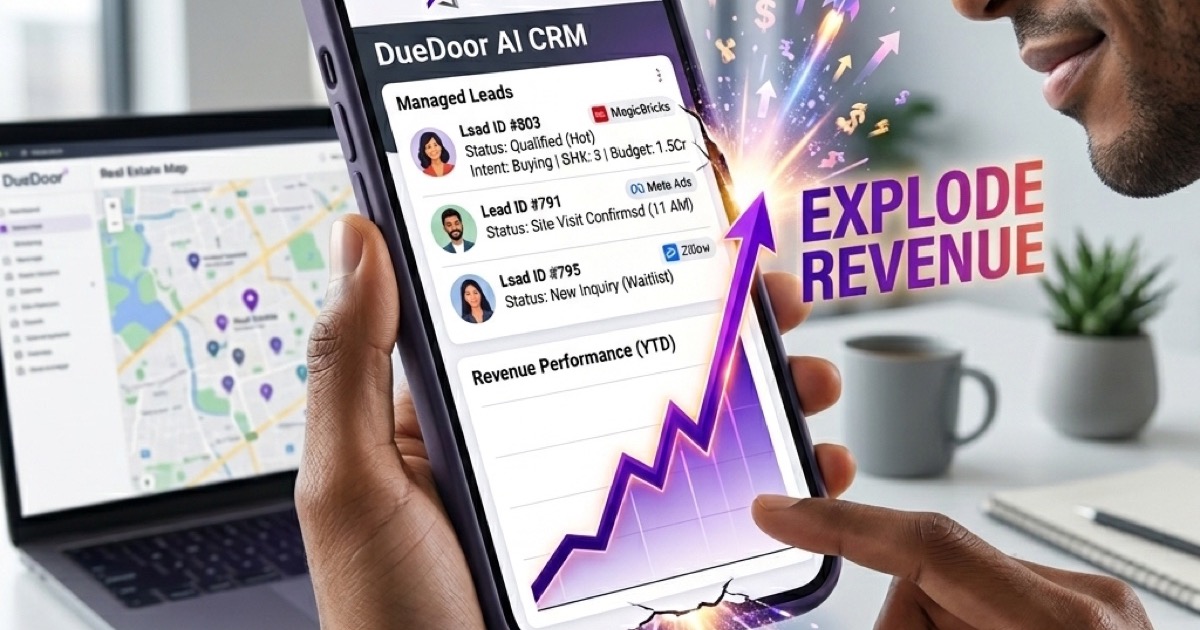
DueDoor's AI Growth CRM is purpose-built for this workflow. Its AI SDR identifies and scores prospects, its WhatsApp Business API integration automates follow-up sequences, and its LinkedIn outreach engine manages connection cadences across multiple team members simultaneously. For teams evaluating CRM options by industry, the CRM comparison for Indian real estate is a useful benchmark for how feature requirements differ across verticals.
Common Mistakes That Invite Low Quality Leads
Understanding what to do is only half the picture. Equally important is avoiding the habits that actively attract the wrong prospects and inflate your pipeline with noise.
- Vague value propositions: "We help businesses grow" attracts everyone and qualifies no one. "We help D2C brands in India automate their WhatsApp follow-up sequences to recover 20 to 30 percent of abandoned carts" attracts exactly the right buyer and immediately repels everyone else. That repulsion is a feature, not a bug.
- Broad ad targeting: Optimising for clicks and impressions rather than form fills from a specific audience segment fills your pipeline with curiosity clicks, not buyers. Narrow your targeting aggressively even if it raises your CPL on paper. The cost per qualified lead will drop.
- No gate on high-value content: Giving away your ROI calculator or detailed case study without even a basic form means you lose the identity of your most engaged prospects. A light gate (name, work email, company size) is a fair exchange.
- Ignoring the follow-up stage: Nearly 80 percent of sales require five or more follow-up touches. Teams that follow up once or twice leave the majority of their qualified pipeline unconverted. A structured follow-up system, like the one described in the guide on following up with leads over WhatsApp, is non-negotiable for Indian SMB markets where buying decisions move at a relationship-driven pace.
Measure and Iterate for Continuous Improvement
Attracting high quality leads is not a one-time setup. It is a continuous feedback loop between your marketing signals and your sales outcomes. The metrics that matter most are not vanity metrics like traffic or follower counts. They are conversion metrics that trace a clear line from first touch to closed revenue.
Track these five numbers every week:
- Lead-to-qualified-lead rate: What percentage of all leads that enter your pipeline cross your scoring threshold? If it is below 20 percent, your top-of-funnel targeting is too broad.
- Qualified-lead-to-demo rate: How many scored leads agree to a discovery call or demo? If it is below 30 percent, your outreach messaging or response speed needs work.
- Demo-to-proposal rate: How many demos result in a formal proposal? This reflects the quality of your discovery process.
- Proposal-to-close rate: Industry benchmarks vary, but tracking this against your own historical average is more useful than any external benchmark.
- Average deal size by lead source: Knowing which channels produce the highest-value customers, not just the most customers, tells you where to concentrate your acquisition budget.
Once you know where the biggest drop-off point is in your funnel, you have a focused hypothesis to test. Change one variable at a time (messaging, targeting, timing, channel) and measure for two to three weeks before drawing conclusions. This discipline compounds over quarters into a lead generation engine that improves itself.
The final step in every high quality lead journey is a smooth handoff from marketing nurture to active sales conversion. For a practical playbook on closing the loop, the guide on how to convert leads into customers covers the conversation frameworks and timing strategies that turn a warm prospect into a signed contract.
If you are ready to put these strategies into practice with an AI-powered CRM built specifically for ambitious sales teams, try DueDoor free. Set up your ICP, connect your WhatsApp and LinkedIn channels, and let the AI lead scoring engine surface your best opportunities automatically, so your team spends every hour where it counts most.
Frequently Asked Questions
What is the fastest way to improve lead quality without increasing ad spend?
Narrow your targeting criteria and tighten your value proposition so your message only resonates with buyers who match your ICP. Adding a qualification question to your lead capture forms (such as company size or current tool stack) also filters out poor-fit prospects before they enter your pipeline.
How do Indian SMBs typically attract high quality leads on a limited budget?
WhatsApp Business outreach combined with LinkedIn prospecting is the most cost-effective stack for Indian SMBs. Both channels have high engagement rates in India, and when paired with a CRM that automates follow-up sequences, a two-person team can manage a pipeline of 200 to 300 active prospects without additional headcount.
What is lead scoring and why does it matter for lead quality?
Lead scoring assigns numerical values to each prospect based on how closely they match your ICP and how actively they are engaging with your content. It matters because it ensures your sales team always prioritises the highest-probability opportunities first, reducing time wasted on prospects who are unlikely to convert.
How many touchpoints does it typically take to convert a high quality lead?
Research consistently shows that most B2B sales require between five and eight meaningful touchpoints before a prospect agrees to a purchase. For Indian SMB markets, where trust and relationship are central to buying decisions, the number can be even higher, which makes automated but personalised nurture sequences essential.
Can automation hurt lead quality by feeling impersonal?
Poorly configured automation can feel impersonal, but the solution is personalisation at the template level, not removing automation. Using the prospect's industry, pain point, and specific behaviour (the page they visited, the content they downloaded) in your automated messages makes them feel individually crafted even when they are sent at scale.
Every lead gets an instant, qualified reply — even at 3 AM
DueDoor's AI reads the inbound WhatsApp, understands pricing/demo/support intent, replies with the right answer, and books the meeting — all in under 4 seconds. No human lifts a finger until the call itself.
- AI understands Hindi, Tamil, Telugu, Marathi, English
- Qualifies budget, team size, timeline automatically
- Books into your actual Google/Outlook calendar
- Escalates to a human only when the AI isn't 95%+ sure
WhatsApp AI
Auto-reply, drip sequences, AI qualification — 24/7.
Leads & Pipeline
Smart lead scoring with auto-routing to your team.
Email Marketing
Personalized AI emails that actually get opened.
Meta Ads AI
One-click campaigns optimized by AI daily.
SEO Engine
Content + ranking on autopilot. Like this page.
LinkedIn (PhewDo)
Outreach + replies handled end-to-end.
References & further reading
- Lead generation — Wikipedia
- HubSpot Marketing Blog
- Marketing — Wikipedia
- Digital marketing — Wikipedia
- Sales — Wikipedia