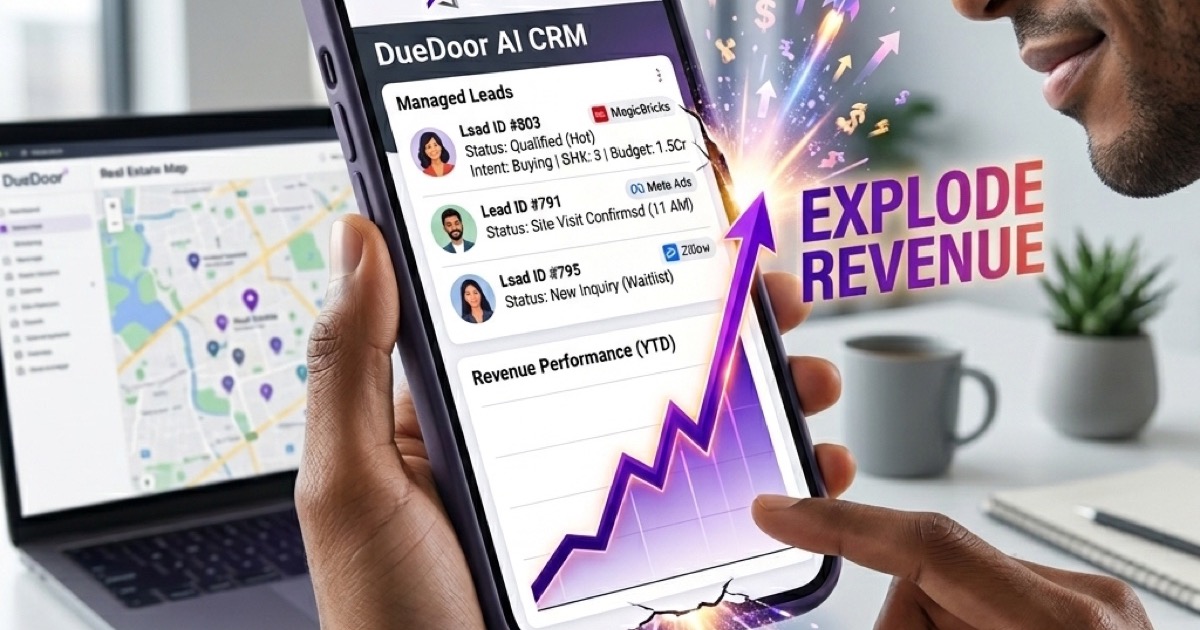
The top email automation platforms for SMBs in 2026 include Mailchimp, Brevo, ActiveCampaign, Zoho Campaigns, and DueDoor, each offering unique strengths in segmentation, drip sequences, and CRM integration. Choosing the right one depends on your budget, list size, and whether you need multichannel automation beyond email.
Email remains the highest-ROI digital channel available to small and medium businesses, delivering an average return of 42 rupees or dollars for every one spent. But raw email blasting is dead. What separates growing SMBs from stagnant ones is automation: trigger-based sequences, behavioral segmentation, and lifecycle drips that work while your team focuses on closing deals. Picking the wrong platform, however, can mean paying for features you will never use or missing the ones you desperately need.
This guide cuts through the noise. We have evaluated the leading email automation platforms on criteria that actually matter to Indian SMBs and globally minded small businesses: ease of setup, deliverability, CRM depth, WhatsApp or SMS add-ons, compliance, and total cost of ownership. Whether you are a bootstrapped startup or a 50-person sales team, there is a platform here that fits your stage and budget.
Why Email Automation Matters for SMBs
Manual email follow-ups are the silent killer of SMB sales pipelines. A lead fills in a form at 11 PM, and by the time your team responds the next morning, that prospect has already booked a demo with a competitor who had an automated welcome sequence running. Speed to lead is everything, and automation is the only scalable answer.
For Indian SMBs in particular, the opportunity is enormous. With over 63 million registered small businesses and digital adoption accelerating post-2023, email inboxes are less saturated than WhatsApp. A well-crafted automated drip sequence can nurture a cold prospect from first click to sales-qualified lead without a single manual touch. Platforms like purpose-built automated email marketing tools for startups have made this accessible even for teams without a dedicated marketing hire.
Key Features to Look For
Not every email platform is built for SMB realities. Here are the features that genuinely move the needle:
- Visual workflow builder: Drag-and-drop automation flows that do not require a developer. If you need to write code to set up a drip, the platform is too complex for most SMB teams.
- Behavioral triggers: Send emails based on opens, clicks, page visits, or CRM stage changes, not just scheduled dates.
- Segmentation and tagging: Group contacts by industry, deal stage, location, or custom fields so every message feels relevant.
- A/B testing: Subject line and content testing to continuously improve open and click rates without guesswork.
- CRM integration or built-in pipeline: Email automation in a vacuum is weak. The real power comes when email triggers update deal stages and vice versa.
- Deliverability tools: Dedicated IPs, SPF/DKIM setup guides, and spam-score checkers to ensure your emails actually land in inboxes.
- Reporting and attribution: Revenue attribution per campaign, not just opens and clicks.
Top Platforms Compared
The table below summarizes the leading email automation platforms for SMBs, evaluated on the dimensions that matter most in 2026.
| Platform | Best For | Starting Price (USD/mo) | CRM Built-In | WhatsApp/SMS Add-On |
|---|---|---|---|---|
| Mailchimp | Beginners, e-commerce | $13 | Basic | No |
| Brevo (ex-Sendinblue) | Volume senders, transactional | $9 | Lite CRM | SMS yes, WA yes |
| ActiveCampaign | Advanced automation, B2B | $15 | Full CRM | SMS via Twilio |
| Zoho Campaigns | Zoho ecosystem users, India | $3 | Zoho CRM | Via Zoho One |
| DueDoor | Indian SMBs, multichannel AI | INR pricing | Full AI CRM | WhatsApp native |
| ConvertKit (Kit) | Creators, solopreneurs | $9 | No | No |
| Klaviyo | E-commerce, D2C brands | $20 | No | SMS yes |
Mailchimp is often the first platform SMBs try because of its free tier and brand recognition. It works well for newsletters and simple drip sequences but gets expensive as your list grows and lacks deep CRM features. Brevo offers better value per contact and added WhatsApp Business API support in 2026, making it a strong contender for Indian teams that need both email and WhatsApp in one dashboard.
ActiveCampaign is the power-user's choice. Its automation builder is the most sophisticated of the mainstream platforms, supporting conditional logic, lead scoring, and deep CRM pipeline stages. The trade-off is a steeper learning curve and higher pricing once you move beyond 1,000 contacts. For teams already comfortable with structured cold email outreach best practices, ActiveCampaign's sequencing tools reward that discipline with measurable conversion lifts.
Pricing and Value for Indian SMBs
Rupee-denominated billing and GST invoicing are non-negotiable for most Indian businesses claiming input tax credits. Zoho Campaigns is the standout here: priced in INR, deeply integrated with Zoho CRM (which many Indian SMBs already use), and available at roughly Rs 210 per month for 500 contacts on the Standard plan. For bootstrapped founders, that is hard to beat.
DueDoor takes a different approach entirely. Rather than offering email as a standalone module, it embeds email automation inside a broader AI-powered growth CRM that also handles WhatsApp Business API, LinkedIn outreach, AI calling, and pipeline management. For an Indian SMB that wants to run coordinated multichannel campaigns from a single INR-billed platform, DueDoor eliminates the cost and complexity of stitching together five separate tools. The email drip engine triggers off CRM stage changes, so when a lead moves from "interested" to "proposal sent," the right follow-up sequence fires automatically.
Understanding cultural nuances also matters. Subject lines, send times, and content that resonates with a Mumbai B2B buyer differ from what works for a Tier-2 city retail prospect. Reviewing email marketing practices tailored for Indian audiences before configuring your sequences can meaningfully improve open rates without any platform change.
Integration and Multichannel Needs
Email automation does not exist in isolation. Your email platform must talk to your CRM, your website forms, your WhatsApp tool, and ideally your LinkedIn outreach stack. The days of email-only nurture are over: multichannel sequences that combine email, WhatsApp, and LinkedIn touchpoints outperform single-channel by 3.2x on lead-to-meeting conversion rates.
"We cut our sales cycle from 21 days to 9 days after moving to a platform where email sequences automatically hand off to WhatsApp reminders when a prospect goes cold. The key was having both channels in the same workflow, not two separate tools." - Growth lead at a Bengaluru B2B SaaS company using DueDoor
If you are evaluating standalone email platforms, prioritize those with native Zapier or Make (Integromat) support and documented webhooks. Mailchimp, ActiveCampaign, and Brevo all have strong integration ecosystems. But if your team is spending more than two hours a week managing integrations between tools, that is a signal to evaluate a unified platform instead. It is also worth understanding how email marketing compares to social media marketing in terms of owned-channel control and long-term ROI before allocating budget.
Compliance and Deliverability
Indian businesses sending commercial email must comply with TRAI's Distributed Ledger Technology (DLT) registration requirements for transactional and promotional messages, as well as India's IT Act provisions on spam and data privacy. Globally, GDPR applies to any European contacts and CAN-SPAM governs US recipients. Choosing a platform that supports double opt-in, unsubscribe management, and suppression lists is not optional; it is a legal baseline.
On deliverability, shared IP pools are a gamble. If another sender on your platform's shared IP gets blacklisted, your open rates suffer. Platforms like ActiveCampaign and Brevo offer dedicated IPs on higher-tier plans. For high-volume senders (above 50,000 emails per month), that investment pays for itself in recovered deliverability. For a deeper look at the compliance landscape, the email marketing compliance guide for India covers DLT registration, unsubscribe flows, and data localisation requirements in detail.
How to Choose the Right Platform
Decision frameworks help cut through feature-list paralysis. Here is a practical filter for SMBs:
Step 1: Define your primary use case
Are you nurturing inbound leads, running cold outreach campaigns, sending transactional order emails, or doing all three? Each use case has a different platform optimum. Transactional volume favors Brevo or Amazon SES. Cold outreach needs dedicated IP warm-up tools and bounce management. Inbound nurture rewards CRM-native platforms.
Step 2: Audit your current tech stack
If you are on Zoho CRM, Zoho Campaigns is the obvious fit. If you are using HubSpot, its native email automation is included in the CRM cost. Avoid adding a platform that duplicates what you already have. If your stack is fragmented across multiple tools, that fragmentation cost compounds monthly.
Step 3: Run a 30-day pilot
Every serious platform offers a free trial. Import a segment of 200 to 500 contacts, build one automation workflow, and measure deliverability, open rates, and team adoption. Real-world data beats any benchmark report. Most SMBs find they can evaluate two platforms head-to-head within a month without significant time investment.
Step 4: Calculate total cost of ownership
Platform price is only one component. Factor in onboarding time, integration maintenance, the cost of a developer if needed, and the value of features you will actually use. A Rs 500/month tool that your team uses well beats a Rs 2,000/month enterprise platform that gets abandoned after 90 days.
Getting Started with SMB Email Automation
Start small and iterate. Your first automation should be a five-email welcome sequence for new leads: an immediate value-delivery email, a use-case or case study email on day 2, a social proof email on day 4, a soft offer on day 7, and a breakup email on day 10 if there is no engagement. This single sequence alone will outperform any manual follow-up process and gives you a baseline to optimize against.
Once your welcome sequence is running and producing data, layer in behavioral triggers. Send a targeted case study when a prospect clicks on a specific product page. Trigger a discount offer when a lead has opened three emails but not booked a demo. These behavioral sequences consistently produce 2x to 4x higher click-through rates compared to time-based drips alone. For teams building their first automation stack, the email marketing best practices guide for India provides a practical checklist covering list hygiene, segmentation, and send-time optimization specific to Indian market conditions.
The platforms that win long-term are the ones your team actually uses. Fancy features mean nothing if the interface causes your marketing manager to revert to manual Gmail follow-ups. Prioritize adoption, then sophistication. DueDoor's onboarding team works with Indian SMBs specifically to configure the first three automation sequences in the first week, so you are generating ROI before the trial period ends.
Ready to see how a unified AI growth CRM handles email automation alongside WhatsApp, LinkedIn, and your full sales pipeline? Start your free DueDoor trial and have your first automated email sequence running today, without a developer, without a lengthy setup call, and without paying for a separate tool for every channel.
Frequently Asked Questions
Which email automation platform is best for small businesses in India?
Zoho Campaigns is excellent for Zoho CRM users with its INR pricing and GST invoicing. Brevo offers strong value with WhatsApp add-ons. DueDoor is the best choice for SMBs that want email automation embedded inside a full AI CRM with native WhatsApp Business API support, all billed in rupees.
How much does email automation cost for an SMB?
Costs range from free (Mailchimp up to 500 contacts) to Rs 200 to Rs 2,000 per month for most SMB plans depending on list size and feature tier. Factor in the total cost including integrations, not just the base subscription price.
What is the difference between email marketing and email automation?
Email marketing typically refers to manually sent broadcast campaigns to a list. Email automation means trigger-based sequences that send the right message at the right time based on user behavior, CRM stage, or time delays, without manual intervention for each send.
Do I need to register with TRAI DLT to send marketing emails in India?
DLT registration under TRAI primarily applies to SMS and telemarketing calls. For commercial email, compliance under India's IT Act and DPDP Act 2023 covers consent, opt-out mechanisms, and data handling. Always include an unsubscribe link and honor opt-outs within 10 business days.
Can email automation work with WhatsApp campaigns?
Yes, and multichannel sequences combining email with WhatsApp follow-ups significantly outperform email-only campaigns. Platforms like Brevo and DueDoor support both channels natively. For other platforms, Zapier or Make integrations can bridge email triggers to WhatsApp Business API messages.
Every lead gets an instant, qualified reply — even at 3 AM
DueDoor's AI reads the inbound WhatsApp, understands pricing/demo/support intent, replies with the right answer, and books the meeting — all in under 4 seconds. No human lifts a finger until the call itself.
- AI understands Hindi, Tamil, Telugu, Marathi, English
- Qualifies budget, team size, timeline automatically
- Books into your actual Google/Outlook calendar
- Escalates to a human only when the AI isn't 95%+ sure
WhatsApp AI
Auto-reply, drip sequences, AI qualification — 24/7.
Leads & Pipeline
Smart lead scoring with auto-routing to your team.
Email Marketing
Personalized AI emails that actually get opened.
Meta Ads AI
One-click campaigns optimized by AI daily.
SEO Engine
Content + ranking on autopilot. Like this page.
LinkedIn (PhewDo)
Outreach + replies handled end-to-end.